The first problem companies face when adopting SEO is deciding what to work on first. Without a clear understanding of what on-page, off-page, and technical SEO each address, teams end up swapping plugins on a site that actually needs better content, or spending outreach budget promoting pages that are not even indexed. This article compares the roles and key focus areas of the three domains based on Google Search, and outlines the order in which to audit them depending on the state of your website. For the fundamentals of SEO, see "What Is SEO?" first.
What Separates the Three Types of SEO
Before a page appears in search results, a search engine goes through three stages. It accesses the page and collects its content (crawling and indexing), interprets which queries the content is relevant to (content evaluation), and judges its trustworthiness based on citations and links from other websites (authority evaluation). Technical SEO corresponds to the first stage, on-page SEO to the second, and off-page SEO to the third.
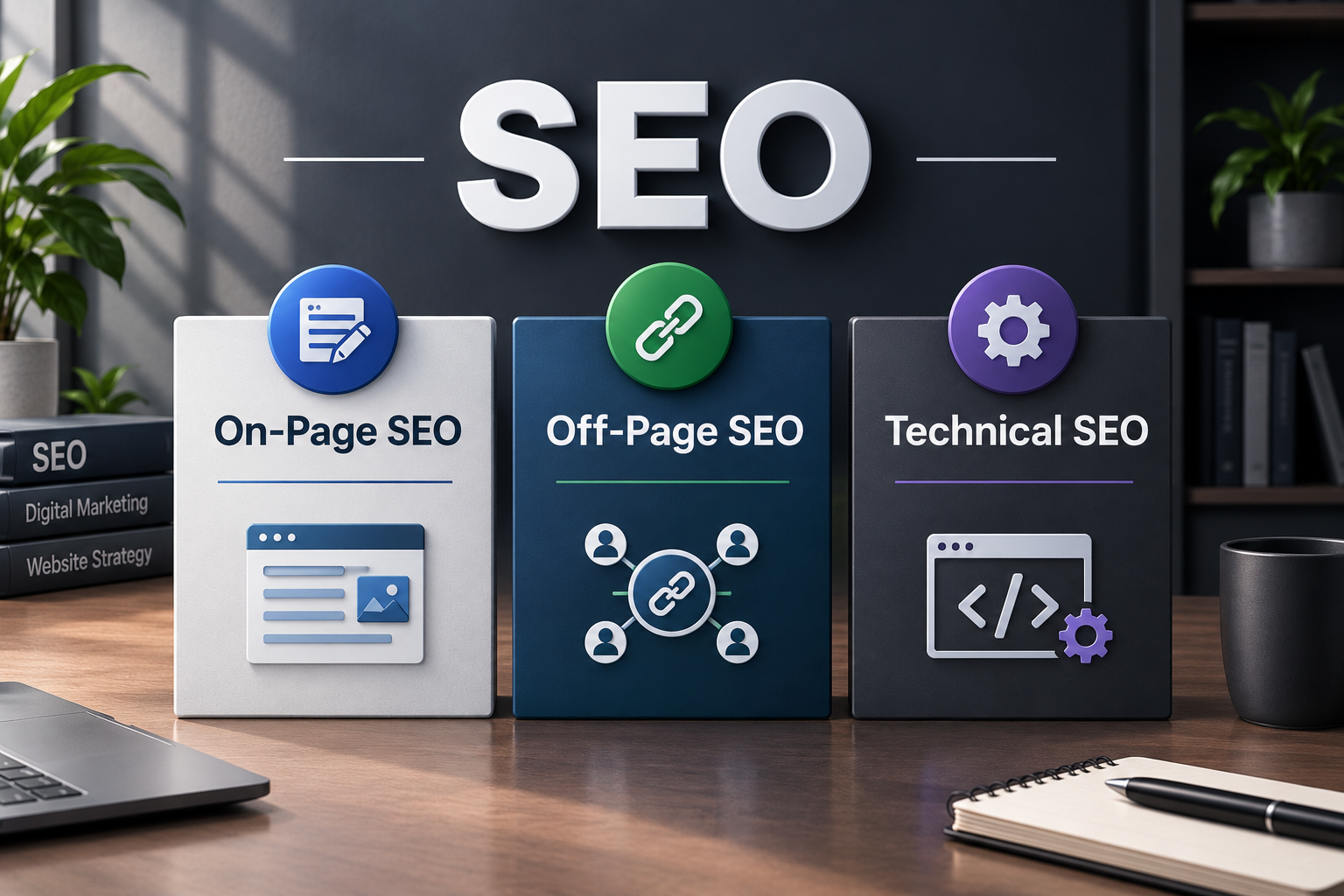
This classification exists to divide up what you audit — it does not mean the three domains operate independently. Internal links span both on-page and technical SEO, and earning external links ultimately requires citation-worthy content on the page. Improving only one domain will only get you so far in occupying the top of search results. Rather than investing equal resources in all three from the start, it is more efficient to identify where the obstacle to search visibility lies and set priorities accordingly.
On-Page SEO: Building Pages That Answer Search Intent
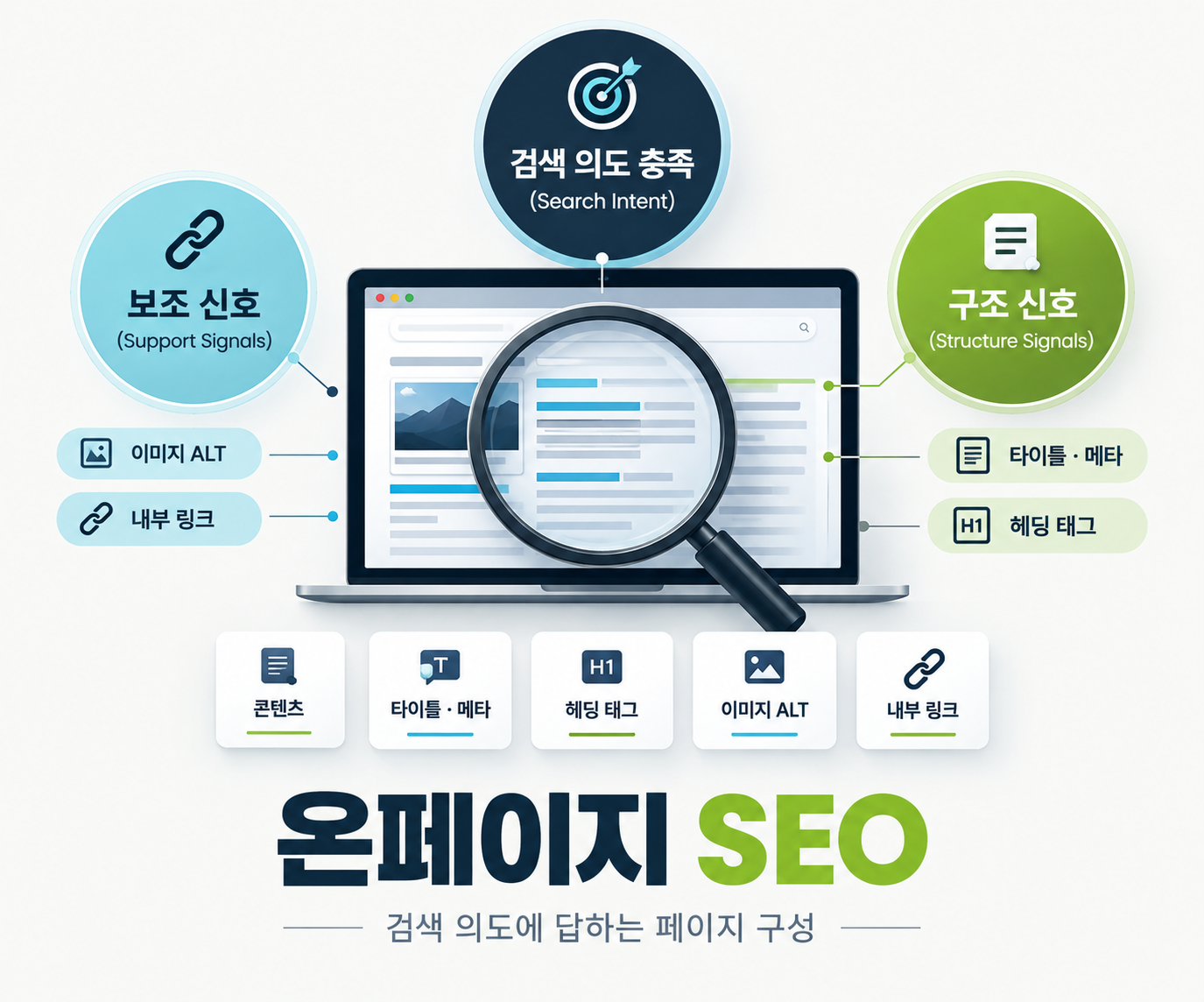
On-page SEO is the work of putting the information users search for onto the page, and structuring it so search engines can interpret it accurately. For a service page, this means covering what customers want to know before contacting you — cost, process, who it is for, expected outcomes — and arranging that information under clear titles and subheadings so it is easy to find.
On-page SEO can be audited along three lines.
Satisfying Search Intent
Check which query the page targets and whether the body contains the information a user typing that query expects. Even for the same keyword, a user looking for a definition, a user comparing options, and a user requesting a quote each expect different content.
Searching the keyword yourself and reviewing how the top-ranking pages answer it — in what format and at what depth — gives you a benchmark for what your target page needs to deliver.
Structural Signals
The title tag is both the headline shown in search results and the primary evidence search engines use to determine the page's topic. The meta description is the summary shown in search results; while it does not directly determine clicks, including the body's core keywords and related expressions broadens the range of queries the page can respond to.
Heading tags (H1–H3) convey the logical structure of the body to search engines, so actual subheadings must be distinguished from text that was merely enlarged for design purposes.
Supporting Signals
Image alt text supplements the information an image conveys in text form, and internal links connect related pages so search engines can understand how topics relate to one another within the site.
The main checklist items are:
- Content: Does it sufficiently answer the search intent of the target query?
- Title tag and meta description: Is the page topic clear, and are the core keywords included?
- Heading tags: Do they follow the flow and hierarchy of the body?
- Image alt text: Is the information in images described in text?
- Internal links: Do they connect to related pages with clear anchor text?
Depending on your website management tool, titles, body text, and image descriptions can be edited without development knowledge. Start by picking the single most business-critical service page and checking whether any information customers would look for via search is missing.
That said, which query to target and where your page currently ranks for it can only be judged after analyzing search volume and competing pages.
Off-Page SEO: Earning Trust Through External Citations and Links
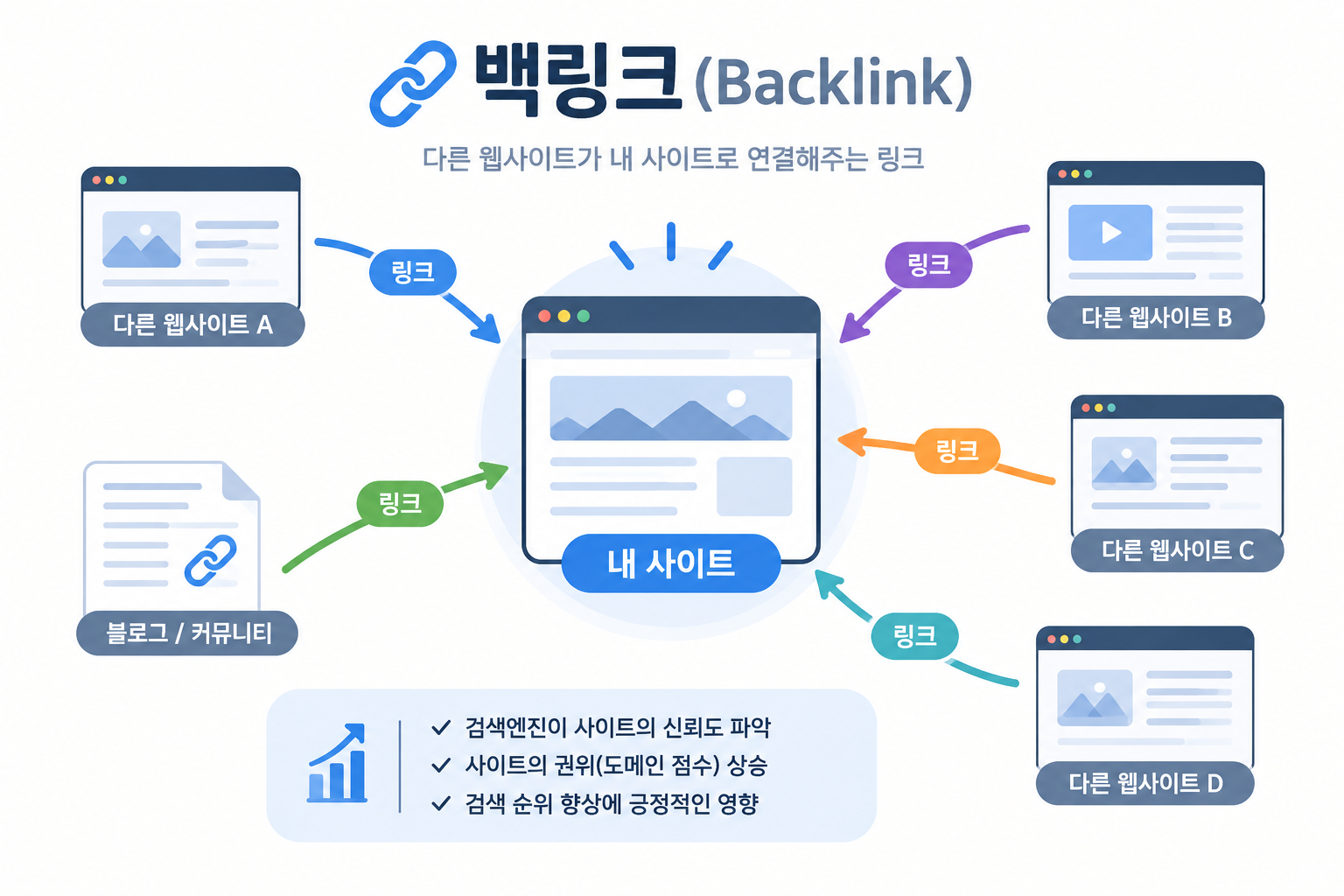
Off-page SEO is the practice of raising a domain's trustworthiness and authority through signals that occur outside your website. Search engines use how often other websites cite and link to a page as evidence of that page's value.
When an industry publication cites your research and links to the source, that link becomes a path to the original for readers — and a clue for search engines to discover and evaluate the page.
Off-page SEO can likewise be divided into three areas.
Backlinks
Links from other websites to your pages are the core of off-page SEO. What matters, however, is not the number of links but the relevance and trustworthiness of the linking site. Links acquired in bulk from unrelated sites, or purchased links, are not only ineffective but can trigger search engine penalties.
Brand Mentions and Reputation
Even without a link, being mentioned in industry media, communities, and review platforms acts as a trust signal in itself. In B2B especially, client case studies, partnership announcements, and expert columns play this role.
Content Distribution
This is the activity of delivering content to interested readers through social media, newsletters, and external channels, encouraging visits and shares. It does not feed directly into rankings, but the wider your content's exposure, the more likely it is to lead to citations and links.
The main activities are:
- Earning backlinks: Providing citation-worthy research, guides, and case studies that attract natural links
- Introducing your brand and content: Offering useful information to industry media and relevant communities
- Promoting via social and external channels: Delivering content to readers to drive visits and shares
When measuring outreach results, separate "were links actually acquired" from "was the content shared or did it drive visits." Start by checking whether your website has resources that industry peers or customers would find worth referencing, and share them in relevant channels.
Whether external media feature or link to you is not something you can decide directly, and which links are actually being counted in evaluation can only be known by analyzing your backlink profile. Off-page SEO is therefore closer to a long-term strategy of steadily accumulating and promoting useful content to earn external citations.
Technical SEO: An Environment Search Engines Can Read
Technical SEO is the work of auditing and improving the technical environment so search engines can access your website, collect its content, and reflect it in search results. The core tasks are identifying settings that block crawling and indexing, and checking page speed and mobile usability.
In construction terms, it is the foundation that supports the building — if this layer has problems, no amount of content improvement will get your pages into search results.
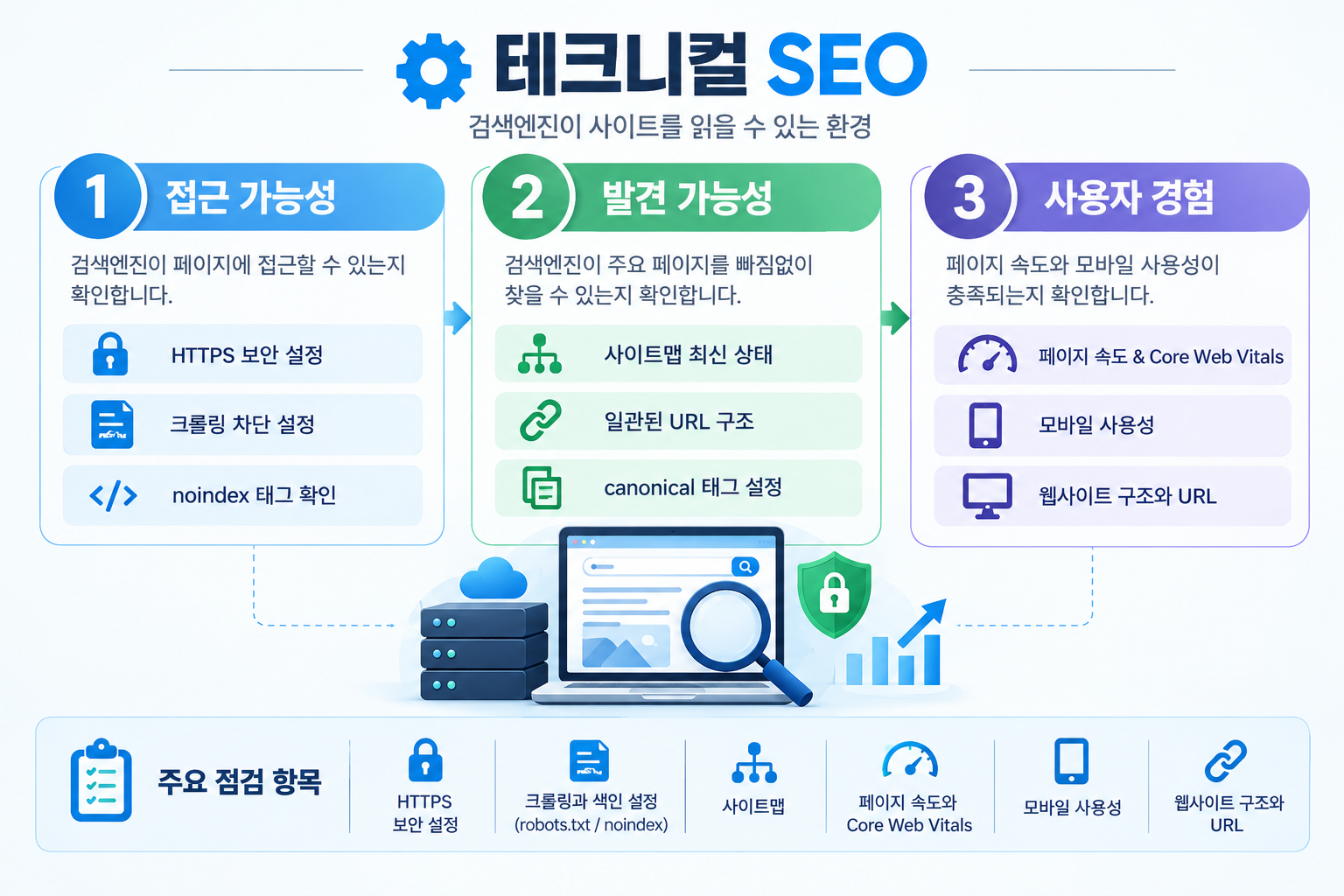
Technical SEO can be broken into three stages of auditing.
Stage 1: Accessibility
Check whether any settings block search engines from reaching your pages: whether robots.txt is blocking paths that should be visible, whether stray noindex tags remain on individual pages, and whether HTTPS is properly applied. It is surprisingly common for blocking rules set up during development to remain on the live site.
Stage 2: Discoverability
Check whether the site's structure lets search engines find every important page: whether the sitemap is submitted and up to date, whether the URL scheme is consistent with a clear hierarchy, and whether canonical tags designate a representative URL when the same content is exposed under multiple URLs.
Stage 3: User Experience
Check page speed and Core Web Vitals (loading speed, responsiveness, visual stability), and whether content is easy to read and menus and buttons easy to use on mobile. Google evaluates pages based on the mobile version, so reviewing only the desktop view can hide problems.
The main checklist items are:
- HTTPS: Is the secure connection properly applied?
- Crawling and indexing settings: Are robots.txt and noindex blocking pages that should be visible?
- Sitemap: Is the list of key pages provided and up to date?
- Page speed and Core Web Vitals: Do loading speed, responsiveness, and visual stability meet the thresholds?
- Mobile usability: Can content be read and controls operated smoothly on mobile?
- Site structure and URLs: Are page connections and the URL scheme clear?
Start with the URL Inspection tool in Search Console to check the index status of your key pages. If a page that should appear in search has noindex set, it needs fixing. Note, however, that non-indexing has many possible causes — blocking rules, duplicate content, crawl errors, quality assessments — so review the reason shown in the inspection result and act on the actual cause.
Items requiring server configuration or code changes need to be coordinated with developers, and even pinpointing which layer a problem sits in often demands professional diagnosis. For how to audit each item, see "7 Technical SEO Essentials".
The Three Types of SEO Compared
| Category | On-Page SEO | Off-Page SEO | Technical SEO |
|---|---|---|---|
| Role | Content that answers search intent | Trust earned via external citations and links | A technical environment that allows crawling and indexing |
| Corresponding stage | Content evaluation | Authority evaluation | Crawling and indexing |
| Where the work happens | Individual pages | Outside the website | Across the entire website |
| Key focus areas | Search intent, structural signals, supporting signals | Backlinks, brand mentions, content distribution | Accessibility, discoverability, user experience |
| Success metrics | Target keyword rankings, CTR | Backlink quantity and quality, brand search volume | Indexed page count, Core Web Vitals |
Where Should You Start?
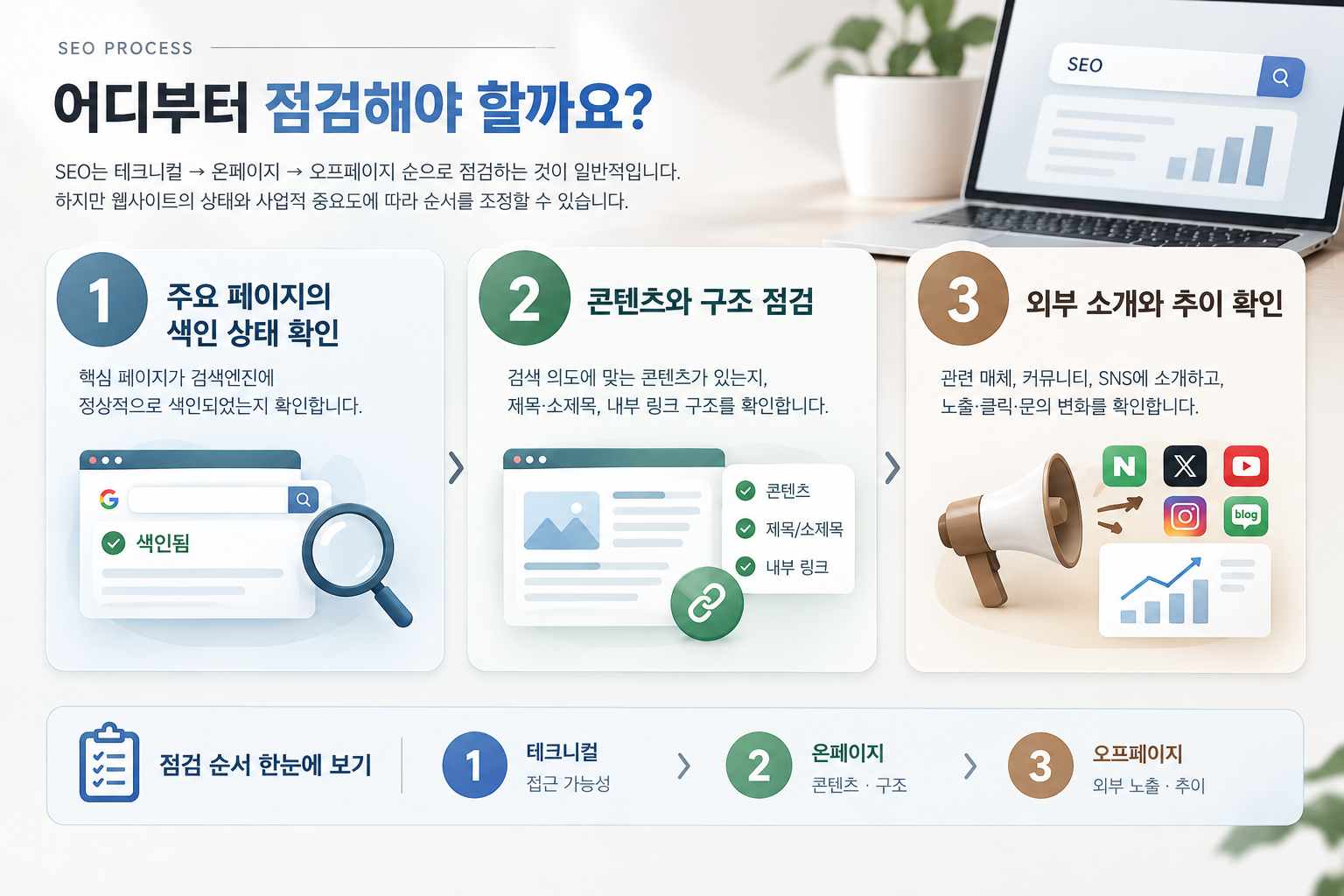
If you are just starting SEO, the usual order is technical, then on-page, then off-page. If search engines cannot access your key pages or the pages are not indexed, improving content and promoting it externally will not show up in search results.
This order is a guideline for the initial audit, though — it does not mean every technical fix must be finished before touching content or outreach. If your business-critical pages are already indexed properly, you can improve content first and run technical fixes in parallel. What matters is deciding, based on the site's condition and each page's business importance, which problems to solve first and which work to run alongside.
The concrete audit procedure is as follows.
① Check the index status of key pages
Pick your core service or product pages and check whether they are indexed using URL Inspection in Search Console. If not, review the reason shown and address the actual cause — technical blocking, duplicate content, or otherwise.
② Audit content and structure
Review whether the indexed pages sufficiently answer the search intent of their target queries. Fill in missing information, and confirm that titles and subheadings accurately reflect the body and that internal links connect to related pages.
③ Promote externally and track the trend
Introduce reference-worthy content to relevant media, communities, and social channels. Then monitor changes in impressions, clicks, and inquiries — but rather than judging effectiveness by rankings immediately after a change, watch the trend over a period before deciding the next improvement.
Common Misconceptions
Failing to distinguish the three domains leads to a few typical misconceptions.
First, "good content will rank on its own." Content quality is an on-page matter; whether that content gets collected by search engines is a technical matter. If a good article has gone unfound in search for months, check its index status before blaming the content.
Second, "installing an SEO plugin solves it." A plugin is a tool that helps with tasks like entering titles and meta descriptions or generating sitemaps — it does not decide which queries to target or what information to include.
Third, "more backlinks means higher rankings." Irrelevant links are either ignored in evaluation or can actively hurt you. The standard is not the volume of links but which site linked to you and in what context.
Closing
On-page SEO covers content and structure that answer search intent; off-page SEO covers trust built through external citations and links; technical SEO covers the technical environment that lets search engines collect your site. The three are not substitutes for one another — they must be in place together, and identifying which domain is blocking your search visibility is the starting point of SEO.
You can check index status and content yourself, but determining which layer is causing a page not to be indexed, what your page lacks against competitors for a target query, and whether your existing external links are actually being counted requires tools and experience.
If you find it difficult to pinpoint the cause or the direction for improvement, consider a website audit through 238LAB's SEO consulting. We diagnose on-page, off-page, and technical SEO end to end, and prioritize improvements around your business-critical pages.

About the Author
Aiden: SEO & GEO Consultant / Marketing
From venture investment to M&A advisory, I design digital growth across the entire corporate lifecycle. As an SEO consultant at 238lab, I focus on building sustainable, data-driven traffic structures. Former Marketing Lead at a venture and startup management consulting firm Former Digital Strategy Team Lead at a corporate finance advisory firm Current Head of Digital Strategy at 238lab