
The 3 Core Elements of WordPress SEO
When doing SEO on WordPress, the three most critical factors are trust, accuracy, and reputation. Google has stated this officially, and WordPress offers a range of plugins to help you address each one.
SEO is ultimately the process of building a site that meets Google's standards. In this article, we cover the various methods for satisfying these three core elements of WordPress SEO.
First, raise your site's trust
The most sustainable way to build trust is to perform "authoritative actions" frequently. Backlinks and other methods also affect trust, but we will address those under reputation. The single most important factor for building trust is, without question, consistently producing good content.
Even a highly authoritative site can gradually lose ranking if it starts publishing poor content over time and traffic declines. On the other hand, even a brand-new site - a blog that is easy to read and publishes quality content - will naturally attract more visitors and climb the rankings over time.
Consistently producing content that both Google and your visitors prefer is harder than it sounds. Anyone who has written posts knows this: if you are not used to writing, a single post can take around 2 hours. Even once you get comfortable, you still need to invest about 1 hour per post. And jumping straight to ChatGPT before you have a sense of the topic may not serve you well.
Beyond writing time, adding indexing and SEO management can push the workload to 2-3 hours a day. Worst of all, if your hard work fails to rank, the repeated disappointment can wear you down mentally. So when you write, templatize as much as possible and publish without loading too much expectation or emotion into each post.
Second, raise your site's accuracy
Accuracy can be viewed from two angles. The first is "keywords," and the second is "site structure."
Keywords
If you are new to WordPress, the first thing to examine is keywords. Think of a keyword as a vehicle that concentrates a customer's needs. Search intent varies from person to person, but the goal is to identify the information people need most.
A good approach is to use Google's Keyword Planner to check the overall metrics for a keyword, then run actual searches to study the intent behind people's queries. This process alone is usually enough for most people to quickly grasp what content they should create.
Site structure
Next, site structure. If you are not used to building sites, you face a situation where you must set everything up from scratch and may not know what to choose. In these cases you may also need to buy a paid theme, which can cost more than expected.
And amid this confusion, you may try to "account for too much" and end up missing the core HTML tags you need to communicate to Google, or slow your site load speed - among various other problems.
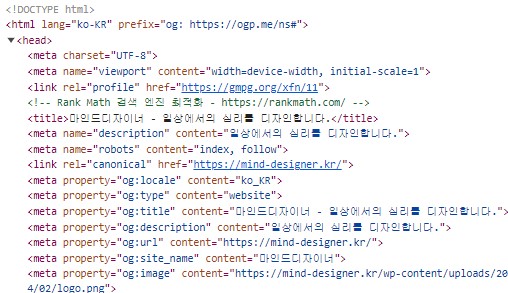
As shown in the HTML structure above, getting a site to appear in search for the first time requires adjusting a variety of tags. If you expect to rank without going through this process, proper indexing is unlikely.
Last, mind your site's reputation
You earn reputation by structuring your site so that it gets mentioned across many other sites. In SEO terms this is called backlinks or link building, and the metric rises the more often users who read your content mention it in authoritative communities.
For Google, backlinks serve as a way to gauge "word of mouth." The power of reviews and word of mouth is significant - as illustrated by the theory of chasm marketing, consumers make roughly 60-80% of their purchases based on word of mouth and validation. In Korea, this phenomenon is even stronger.
Therefore, promoting your site across various platforms to increase how often it is mentioned is both the foundation and a core method for building reputation.

About the Author
Joshua: Lead SEO Consultant
- Built a zero-cost structure generating KRW 1.2 billion in annual revenue through SEO alone - Closed a KRW 700 billion deal through SEO alone - Low-cost, high-efficiency marketing specialist Former) Marketing Lead at a financial services firm Current) Runs SEO/GEO agency 238lab Track record) Led multiple SEO consulting projects, including Korea's No.1 AI community