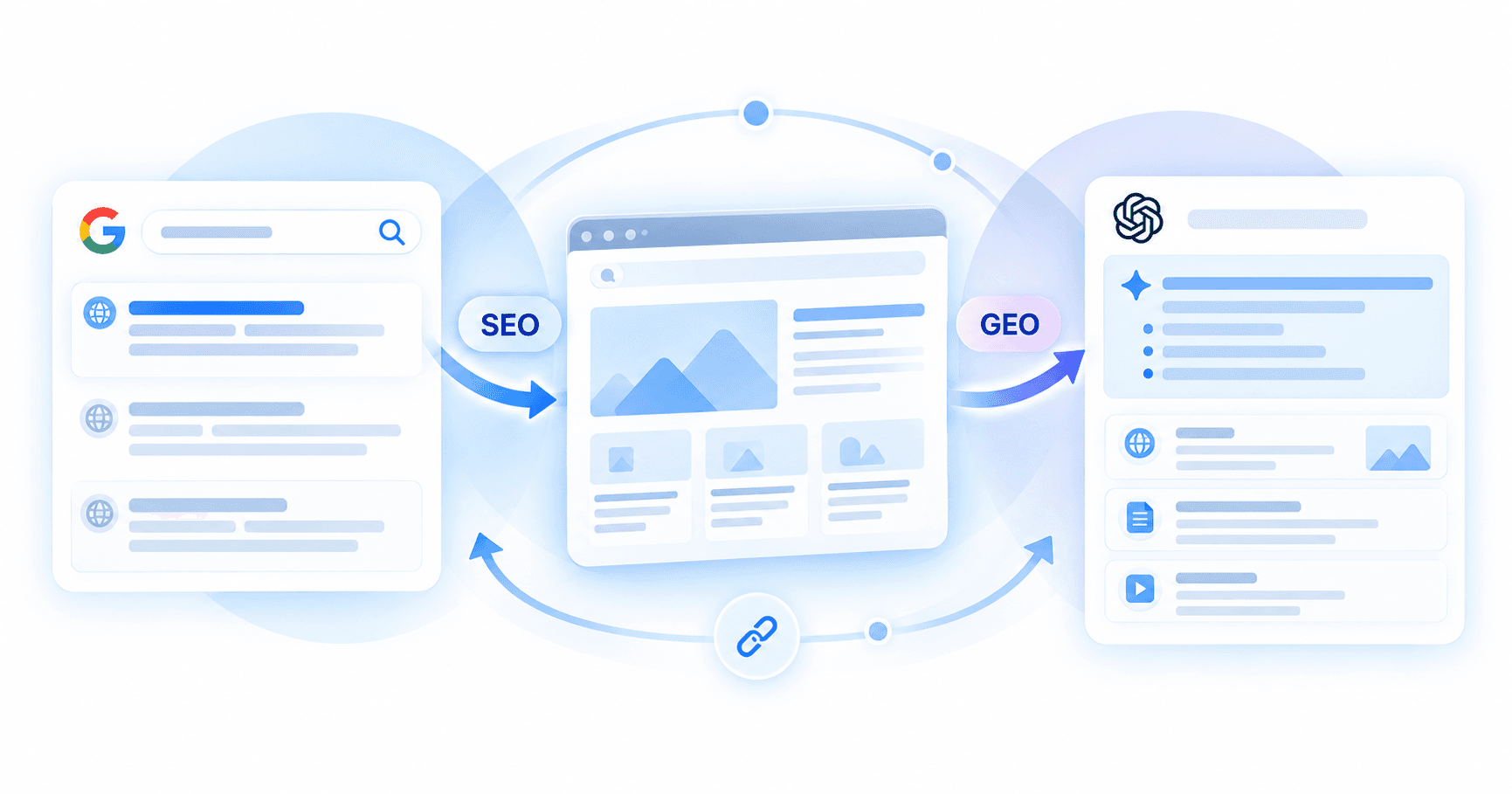

"Can AI actually handle SEO/GEO?" You may not ask us directly during a consulting engagement, but we suspect it's a question that crosses your mind quite often. In fact, some clients start to say, "I tried using AI for our SEO/GEO analysis…" — and then quickly trail off, as if they've said something they shouldn't have.
The short answer: yes, it can. And there's absolutely no reason to feel awkward mentioning your AI use to one of our consultants. We actually welcome it.
For what it's worth, 238LAB actively uses AI for repetitive tasks like tag writing, content drafting, keyword classification, meta information generation, and data summarization. SEO/GEO has always carried a significant invisible workload, and outside of the high-judgment areas, we rely on AI quite heavily ourselves.
For high-repetition tasks — title tags, meta descriptions, alt text, FAQ drafts, Schema drafts — AI is a genuinely powerful productivity tool.
That said, the moment you hand AI the keys and say "handle the SEO/GEO for me," the output tends to plateau at a surprisingly shallow level. SEO/GEO is probably the field where that limitation feels most disorienting.
In one session you'll be told there's no title tag; in another, the meta description is weak; when you go to finalize everything, the H1 structure is a mess; sometimes alt text is missing entirely; other times the AI simply suggests adding Schema.
But that level of feedback is essentially just a technical checklist.
The real difficulty most practitioners experience with SEO/GEO lies one step beyond that. You have to look at the entire site's information architecture, the connections between search intents, the relationship between service pages and content pages, domain authority, content accumulation strategy, AI citation potential, and shifts in the competitive landscape — all at once.
AI becomes a powerful weapon when you already know the direction. But in practice, SEO/GEO is not a matter of configuring a few settings correctly — it's closer to a discipline of managing hundreds of variables and signals as skillfully as possible.

Looking at the publicly known Google Search internal API document leak from 2024, the relevant documentation reportedly spanned more than 2,500 pages and referenced over 14,000 attributes. That said, those documents alone cannot be taken as a definitive map of Google's search algorithm. Google itself warned against drawing incorrect conclusions from the documents without proper context.
"But at least one thing is clear."
Search is a far more complex system than most people assume. It is not a game with a published answer key — it is a domain where you must continuously observe search result changes, indexing shifts, content performance, external signals, and domain context, then validate hypotheses against what you find.
That is why, in this post, we want to go one level deeper than the question "Can AI replace SEO/GEO?" and focus on something more practical.
You Need to Shift How You Think About SEO/GEO First
Before you can use AI effectively for SEO/GEO, there is something more fundamental to change: your perspective on what SEO actually is.
Many people still understand SEO as "the work of getting our page to appear for a specific keyword." Keyword visibility matters, of course. But if you view SEO/GEO purely as a keyword ranking game, you will struggle to use AI well.
SEO/GEO is closer to the work of making search engines and AI recognize your site as a trustworthy source on a particular topic. In other words, rather than targeting a single keyword, it is the practice of consistently embedding into the search system an understanding of: "What problem does this site solve?", "What topics does it have expertise in?", and "What user questions can it answer?"
From a GEO perspective, this becomes even more critical. AI compares, combines, and summarizes multiple sources to answer a user's query. For your brand to be cited, it must be clear which category you play in, what problem you solve, and what questions you can reliably answer.
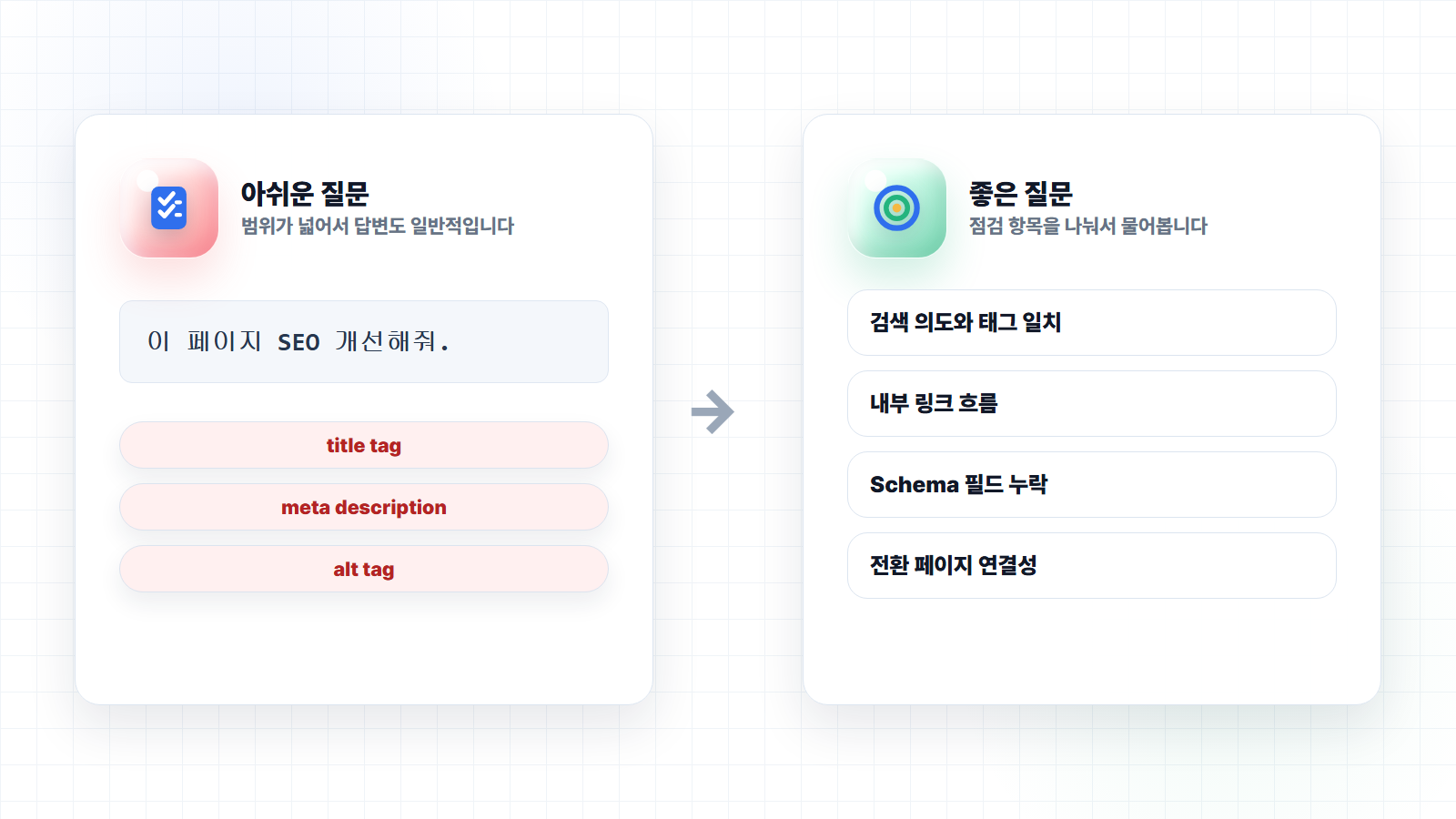
This is why prompting AI with something as vague as this is a missed opportunity:
Improve the SEO on this page.
A better approach is to reframe the question entirely:
Analyze what topic this site is likely to be recognized as an authority on
by search engines and AI.
Based on the current page structure, titles, internal links, and content topics,
identify and organize the site's core and secondary topic categories.
For AI to be a strong partner in SEO/GEO, we first need to shift our own lens — from "keyword exposure" to "site perception design."
Stop Asking AI "What Are the SEO Improvements?"
When you ask AI to "review this from an SEO perspective," there is a high probability you will receive a variation of the same response every time:
- Improve the title tag.
- Add a meta description.
- Clarify the H1.
- Add image alt text.
- Strengthen internal links.
- Implement Schema markup.
None of this is wrong. But it is too broad and too generic. Working at this level makes it nearly impossible to establish real priorities.
In SEO/GEO, you need to decompose your questions. Rather than asking AI to "find areas for improvement," you should first list out the specific audit items you need, then have AI work through each one.
For example, breaking it down like this yields far better results:
Review whether the title tag and H1 on the page below align with search intent.
The target keywords are "GEO consulting," "AI search optimization," and "generative engine optimization."
Organize in a table which intent each tag covers.
Or you might ask:
Analyze the internal link structure of this page.
Suggest how service pages, blog posts, and case study pages should connect to each other.
Rather than a simple link list, organize your recommendations based on search intent and conversion flow.
The same principle applies to Schema. Instead of asking "Should I add Schema?" try this:
Review which Schema type — Service, Article, FAQPage, or Organization — best fits this page.
Organize in a table the required fields for each Schema type and flag any missing information.
AI performs significantly better when the question is specific.
The people who use AI most effectively for SEO/GEO are not those waiting for a great answer — they are the ones who break the problem into precise, targeted audit items before they ever start the conversation.
For the Invisible Layer, You Need to Lean on APIs
Showing AI only the visible page content and asking for SEO/GEO strategy has real limits. AI answers based on the text and structure it can see in front of it.
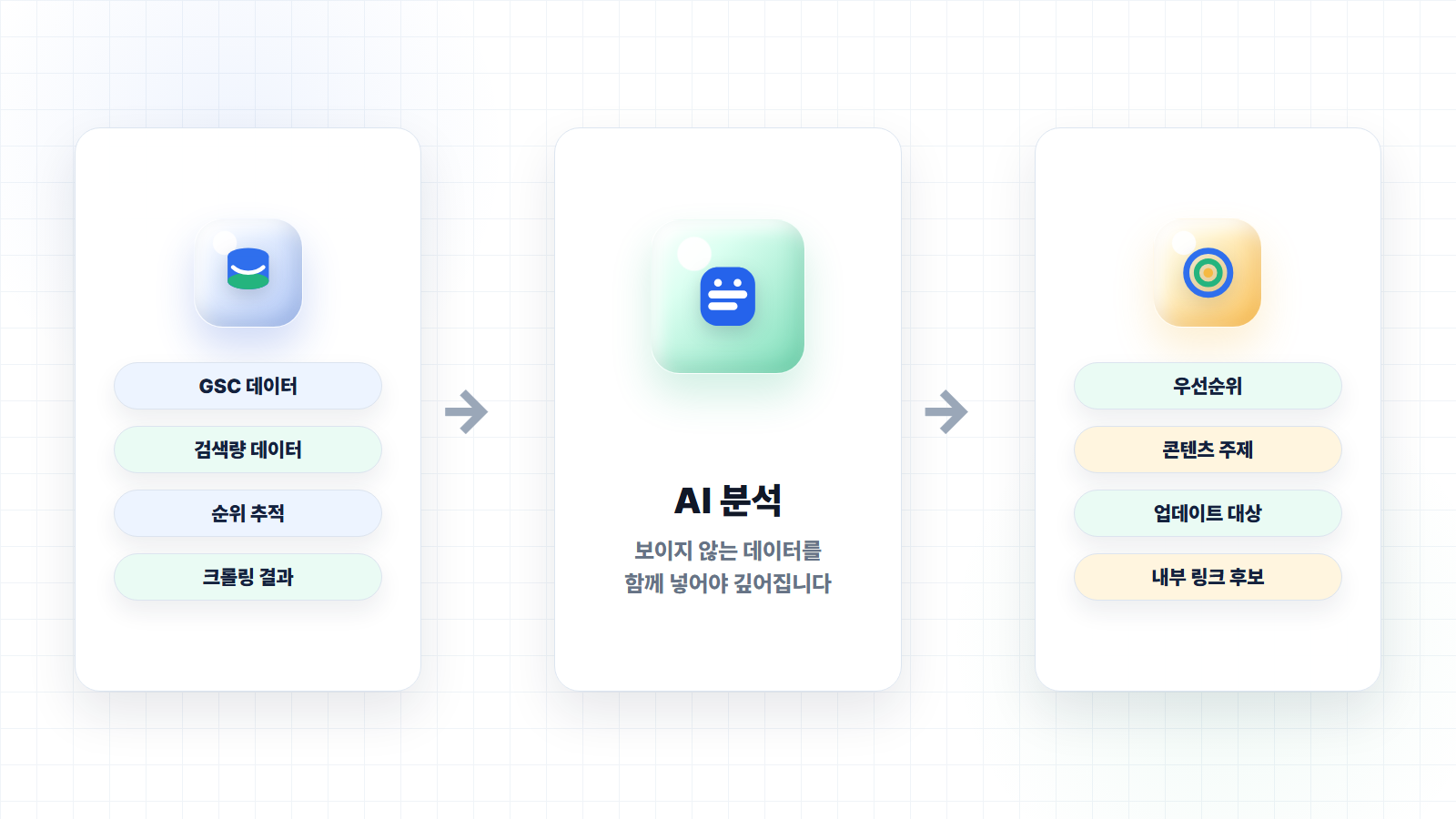
But SEO/GEO runs on a great deal of data that is invisible to the naked eye:
- Which queries are generating impressions
- Which pages are actually earning clicks
- Which queries are trending up or down in ranking
- Which URLs have not been indexed
- Where the brand is being mentioned externally
- Which pages competitors are ranking with
- How search volume differs between Naver and Google
Without this data, any strategy AI produces may sound plausible but will inevitably be shallow. That is why aggressive API integration is essential.
Google Search Console data is the most critical starting point. GSC accumulates data on queries, pages, impressions, clicks, CTR, and average position. Exporting this as a CSV or pulling it via the Search Console API and feeding it to AI alongside your analysis requests yields far more actionable insights.
Here is an example of how to structure that request:
Below is GSC query and page data from the last three months.
Classify the following:
1. Queries with high impressions but low CTR
2. Queries currently ranking between positions 8–20 with strong improvement potential
3. Blog posts that should be internally linked to service pages
4. Question-format queries worth expanding into GEO content
Keyword search volume works the same way. At a minimum, you should be pulling data from the Naver Search Ad API or keyword tools, and where possible, from Google Ads or a manager account (MCC) via Keyword Planner. Asking AI to select keywords without search volume data risks producing well-phrased suggestions that have no real demand behind them.
Third-party APIs are also fair game. Feeding AI data from rank-tracking tools, backlink tools, crawling tools, and brand mention monitoring tools allows it to surface patterns that would be extremely time-consuming for a human to find manually.
The key point: AI does not generate data on your behalf. Its strength lies in summarizing, classifying, and translating data into next actions. Your job is to pull as much of that invisible data as possible and present it in a form AI can actually analyze.
Your Site's Information Architecture Must Be Audited
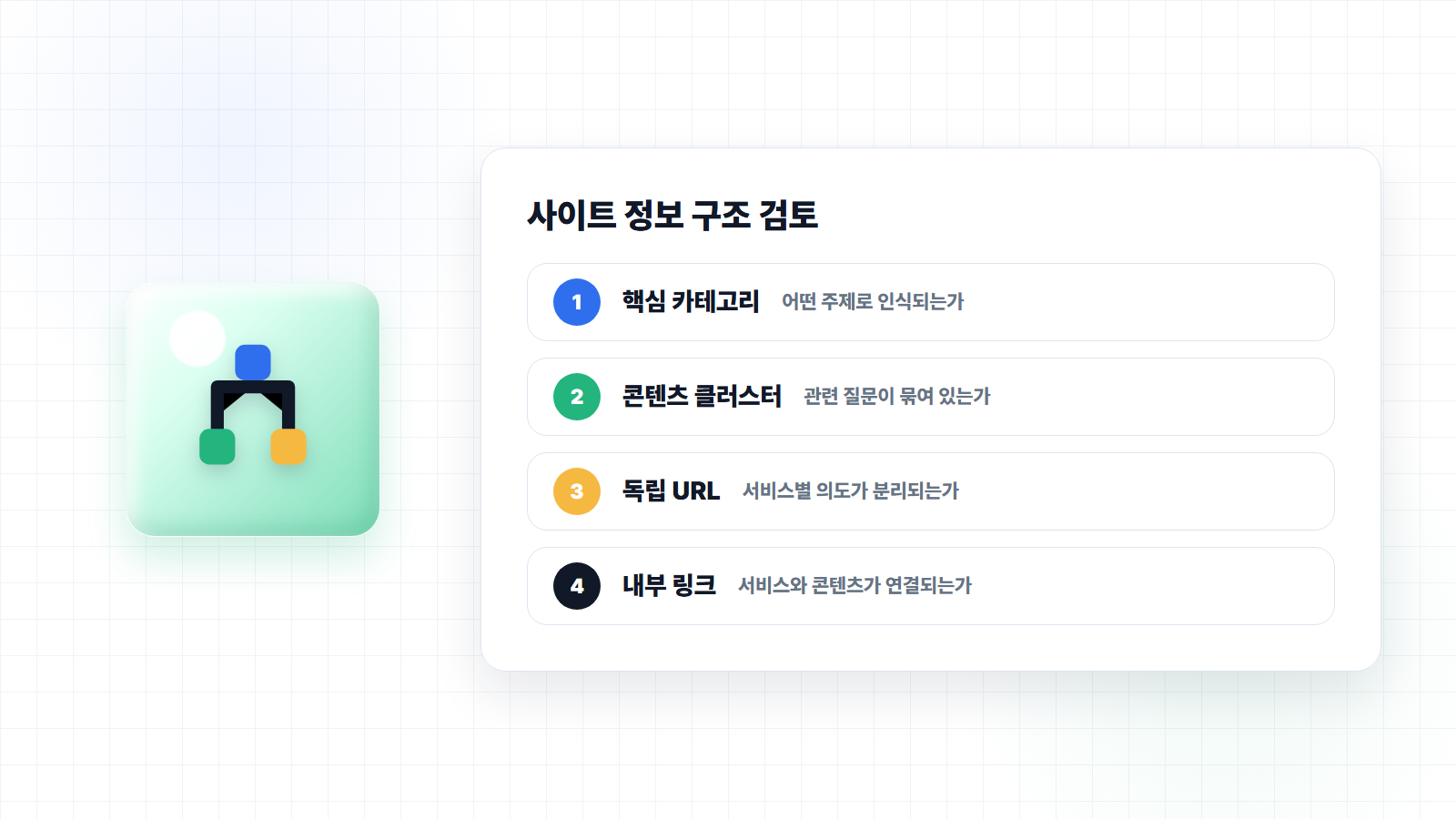
There is one area that absolutely must be reviewed when leveraging AI: your site's information architecture.
In SEO/GEO, the quality of individual pages matters — but so does the overall topical structure of the site as a whole. Google references not just individual pages, but the thematic consistency across the entire site, its internal link structure, content groupings, and external signals.
When related pages within a single topical area accumulate in parallel, it becomes easier for search engines to understand the site's domain of expertise.
For example, a site covering SEO/GEO might logically expand its topic map like this:
/services/seo
/services/geo
/services/technical-seo
/blog/geo-misconceptions
/blog/ai-search-citation
/blog/search-console-analysis
/resources/seo-checklist
/cases/b2b-saas-seo
This structure sends a clear signal to search engines and AI: "This site provides services, educational content, case studies, and resources all within the overarching topic of SEO/GEO." That recognition becomes easier to establish.
Conversely, when all services and content are packed into a single page, when blog posts exist but are never linked to service pages, or when categories are scattered too broadly, search engines and AI can struggle to identify the site's core topic.
You can prompt AI to audit this directly:
Review the sitemap below from an SEO/GEO perspective.
1. What core topic categories is this site likely to be recognized as covering?
2. Where in the current structure does topical focus fragment?
3. Which service areas should be separated into standalone URLs?
4. Which topic clusters should be grouped into a content hub?
Please organize your findings.
Single-page sites deserve particular scrutiny here. That is not to say a single-page structure is inherently bad — it can work well for campaign landing pages or single-product presentations.
However, if you are targeting multiple search intents and multiple service categories simultaneously, a single-page architecture has serious limitations. In that scenario, redesigning the site or building out a content hub architecture may be a more productive first step than attempting SEO optimization on the existing structure.
You Need to Analyze Keyword Relevance Between Service Pages and Content Pages
On many sites, the blog is actively maintained — but remains disconnected from the service pages it should be supporting.
For instance, a blog might cover topics like "What is GEO?", "How to optimize for AI search," and "How Schema impacts GEO performance" — while the service page simply reads something like "Marketing Solutions," broad and abstract. In this scenario, the blog may generate traffic, but it is unlikely to convert that traffic into service page leads.
In SEO/GEO, keyword relevance between service pages and content pages must be evaluated together. The blog should capture informational intent, service pages should capture purchase intent, and case study pages should reinforce trust — each layer connected to the next.
You can ask AI to run this kind of analysis:
Below is a list of our service pages and a list of our blog posts.
Match each blog post to the service page it should be connected to.
Base the matching on search intent, keyword relevance, conversion potential, and internal linking need.
Or frame it this way:
Analyze the primary keywords and natural language expressions in this blog post,
then recommend which service page it would most naturally link to.
Also suggest candidate anchor text options for the link.
The goal here is not to repeat keywords as many times as possible. Keyword density was a concept discussed heavily in earlier SEO, but it is no longer sufficient on its own. What matters now is consistency of core terminology, related entities, search intent coverage, natural language variation, and internal link flow — evaluated together.
The same logic applies from a GEO standpoint. For AI to understand your brand as a credible candidate for solving a specific problem, informational content and service pages cannot be siloed from each other. The structure that needs to exist is: "This brand explains this topic, provides the actual service to address it, and has the case studies to prove it."

AI Should Be Used for Ongoing Management and Tracking
In SEO/GEO, management and tracking are the most important ongoing activities. Publishing content once and moving on is not a strategy that produces durable results.
You need to continuously monitor: which keywords are gaining impressions, which pages are losing rankings, which posts are surfacing for unexpected queries, and which content is driving conversions to service pages.
This work is repetitive and time-intensive — which makes it an excellent use case for AI.
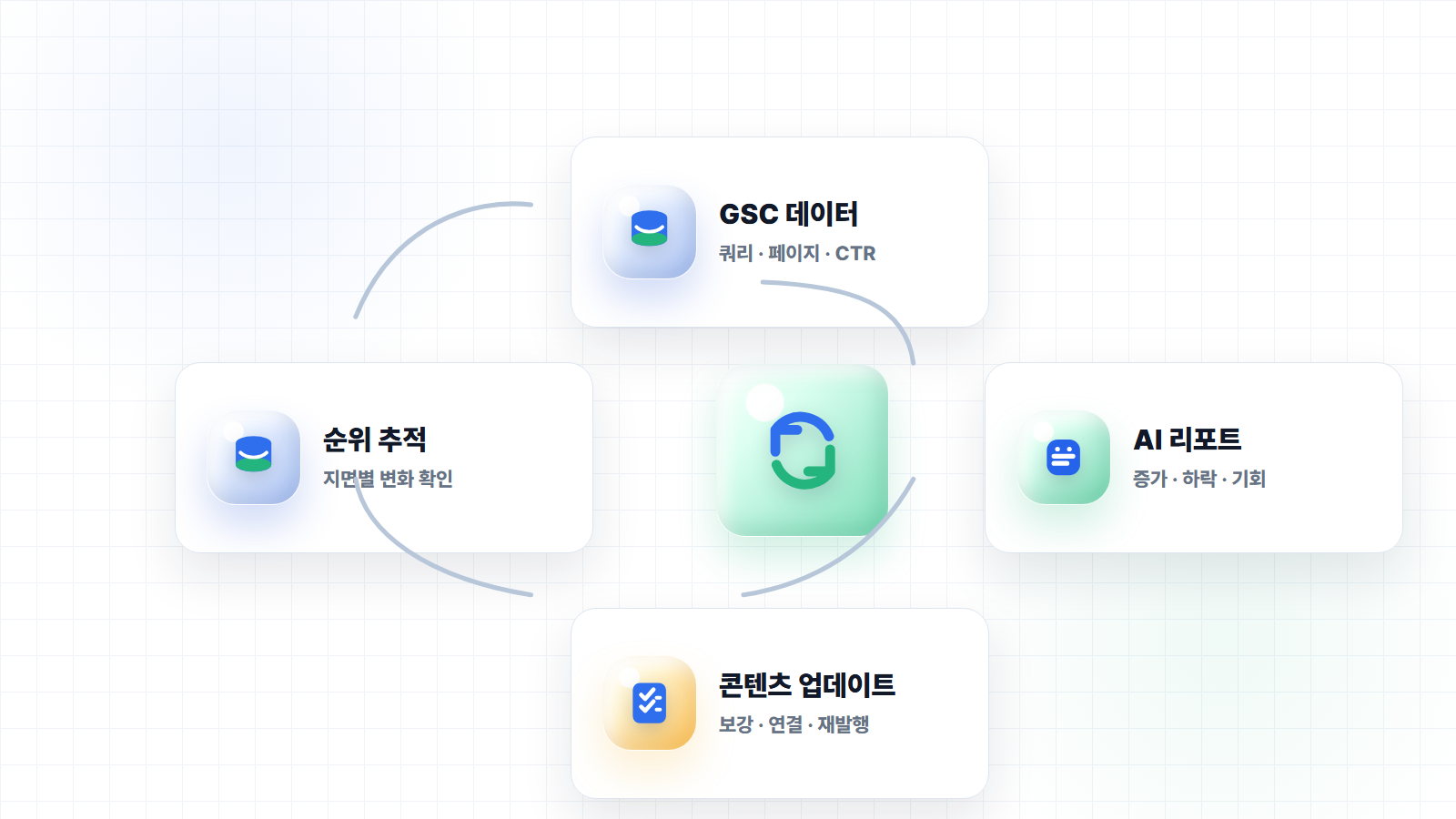
The most fundamental integration is with GSC. Google Search Console grants API access via OAuth, allowing you to pull Search Analytics data on a regular schedule. With query- and page-level data on impressions, clicks, CTR, and average position flowing in consistently, you have the foundation for ongoing SEO tracking.
Layering in third-party rank-tracking tools and crawling tools makes the picture even richer. Tracking rankings by SERP feature allows you to assess which content is appearing for which keywords, which pages need more internal link equity, and which posts are due for an update.
You can delegate monitoring reports to AI like this:
Below is this week's GSC data alongside last week's GSC data.
Please organize the following:
1. Queries with a significant increase in impressions
2. Key pages where clicks have declined
3. Keywords where average position has dropped by 5 or more positions
4. Content that needs to be updated
5. Question-format queries worth expanding into new content
Or on a monthly cadence:
Looking at this month's GSC data, rank-tracking data, and content publishing log together,
recommend SEO/GEO content priorities for next month.
Base the prioritization on search volume, current ranking, conversion potential,
and strength of connection to service pages.
AI excels at this kind of repetitive analysis. It reduces the time spent manually opening spreadsheets to classify queries and pages, and it surfaces patterns that would otherwise be easy to miss. That said, final judgment must remain with a human. Deciding which keywords align with brand direction, which content actually contributes to conversion, and which pages to update are all decisions that still require experience and contextual knowledge.
The More You Use AI, the More Security Matters

As you use AI for SEO/GEO, you will inevitably connect a growing number of external tools and APIs. The integration surface can expand quickly — GSC, Google Ads, Naver Search Ads, rank-tracking tools, crawling tools, analytics platforms, your CMS, and automation platforms can all become part of the stack.
At this point, the single greatest risk is mishandling API keys and OAuth tokens.
SEO/GEO does not operate through one official tool. Because the data you need is distributed across multiple sources, working with a variety of third-party tools is unavoidable. In the process, sensitive credentials start moving around: access keys, refresh tokens, client secrets, ad account permissions, Search Console permissions.
Pasting this information directly into prompts, granting excessively broad permission scopes, or building automations that depend entirely on personal accounts creates meaningful security exposure.
- Do not input API keys or OAuth tokens directly into prompts.
- Start with read-only permissions wherever possible.
- Revoke keys that are no longer in use immediately.
- Manage account permissions under organizational accounts rather than personal email addresses.
- On automation servers or local environments, use environment variables or a secure secrets manager.
- When feeding data into external AI tools, mask sensitive information — including client names, revenue figures, ad spend, and conversion data.
Using AI well and using AI safely are equally important. Because SEO/GEO involves the intersection of external and internal data, loose security practices can create problems far larger than most people anticipate.
In All Likelihood, AI Will Not Be Able to Execute SEO/GEO Perfectly on Its Own.
AI can be used for SEO/GEO. When deployed thoughtfully, it meaningfully increases both the speed and quality of analysis. For repetitive tag writing, content structuring, keyword classification, GSC data summarization, internal link candidate identification, and content update prioritization — AI is already more than capable of playing a practical role in day-to-day work.
But AI will not do everything for you. Tell AI to "just handle the SEO," and it will almost always stop at a surface-level checklist of visible issues.
On the other hand, when you know the direction, supply the right data, decompose your questions into specific tasks, and verify the outputs along the way — AI becomes an extraordinarily powerful analytical tool.
In SEO/GEO, AI is not a universal problem-solver. It is an amplification tool that becomes powerful in the hands of someone who already knows where they are going.
SEO/GEO, in particular, is not a field with a published answer key. The full set of signals and weightings in the search algorithm is not public, and AI-powered search continues to evolve. Ultimately, what matters is the discipline of forming hypotheses based on experience, reading the data, executing, and adjusting — over and over again.
Working through that process on your own is a perfectly valid path. Just be aware that it tends to take longer than expected. A strong partner helps you eliminate unnecessary experiments and identify exactly where your site is blocked, far more quickly than trial and error alone.
238LAB continues to run experiments on how to operate SEO/GEO more efficiently with AI. If you are trying to establish direction, or want a structured diagnosis of your current site's SEO/GEO architecture, we are always glad to help.
References
- Google Search Central, "SEO Starter Guide"
- Google Search Console Help, "Export Search Console data using the Search Console API"
- Google Ads API, "Generate Keyword Ideas"
- Naver Search Ad API Documentation
- The Verge, "Google confirms the leaked Search documents are real"
- SparkToro, "An Anonymous Source Shared Thousands of Leaked Google Search API Documents with Me"
- The Register, "Google's in-house docs about search ranking leak online"

About the Author
Joshua: Lead SEO & GEO Consultant
- Built a zero-cost structure generating KRW 1.2 billion in annual revenue through SEO alone - Closed a KRW 700 billion deal through SEO alone - Low-cost, high-efficiency marketing specialist Former) Marketing Lead at a financial services firm Current) Runs SEO/GEO agency 238lab Track record) Led multiple SEO consulting projects, including Korea's No.1 AI community