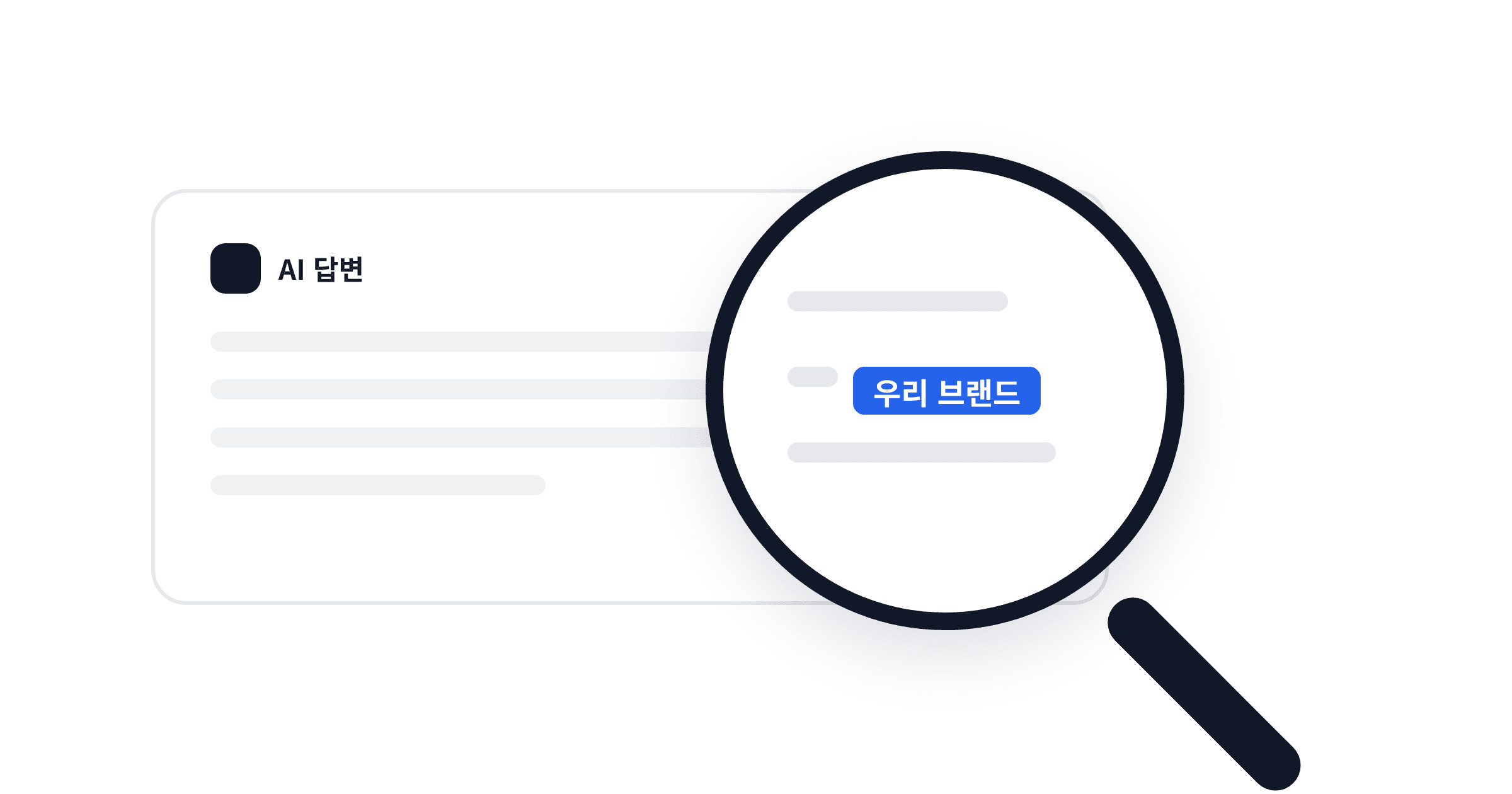

In today’s market, advertising is practically essential when running a business. But if you are generating traffic with a monthly ad spend of KRW 10 million, how much of that traffic remains if you stop advertising next month?
Most people answer, “close to zero.” This is especially common in the Korean marketing market, where paid media plays a dominant role.
If traffic starts when ads go live and disappears when ads stop, that is not an asset—it is a rental. That is because you are paying the same amount every month to borrow the same traffic.
Organic marketing sits on the opposite side of that model. In this column, we will break down what organic marketing is, how it works, and the sequence for converting ad-dependent traffic into compound traffic.
What Is Organic Marketing
Organic marketing refers to the entire traffic structure that brings customers to your brand on their own through search visibility, content, AI citations, and more—without paying media platforms for advertising. True to the word “organic,” once the content and search structure are put in place, they continue generating traffic over time on their own.
To define the scope clearly:
| Category | Organic Marketing | Paid Marketing |
|---|---|---|
| Primary channels | SEO, content, GEO (AI citations), organic social traffic | Search ads (SA), display ads (DA), social ads |
| Cost structure | Upfront investment in production and structure; visibility itself is not charged | Charged per impression or click |
| When paused | Traffic continues (asset remains) | Traffic disappears immediately |
| Performance curve | Starts slowly, then accelerates cumulatively | Starts fast, then plateaus |
| Management perspective | Closer to a compounding investment | Operating expense |
There is one common misconception we need to clear up here. Organic marketing is not “free marketing.” It clearly requires resources for content production, site structure improvements, and data analysis. The difference lies in where the cost goes. Ad spend disappears the moment exposure ends, while resources invested in organic remain in search surfaces and AI citation data, continuing to work for you next month as well.
Ads Follow a Flat Line, Organic Follows a Compound Curve
The fundamental difference between the two is not speed, but the shape of the curve.
The performance curve of advertising is a flat line. Spend KRW 10 million, and you get KRW 10 million worth of traffic. Spend twice as much, and you get twice as much traffic. Since traffic volume is tied directly to budget, growth requires spending to increase at the same pace. And when keyword bidding competition intensifies, the unit cost of acquiring that same traffic often rises.
The performance curve of organic is a compound curve. Published content gets indexed, rankings improve, one page passes trust to another page, domain-wide authority accumulates, and new content begins ranking faster and faster. A page you create this month can still generate traffic next year, and that traffic can accelerate the ranking of the next piece of content—this is what we mean by “compound traffic.”
We cover this structural difference more deeply from a financial perspective in the following column, which we recommend reading together with this one. SEO Is Not a Cost but “a Change in Assets” and the Foundational Work for the AI Era →

The Three Pillars That Make Up Organic Marketing
Organic traffic is not a vague matter of “just working hard on content.” It is a system in which three pillars work together.
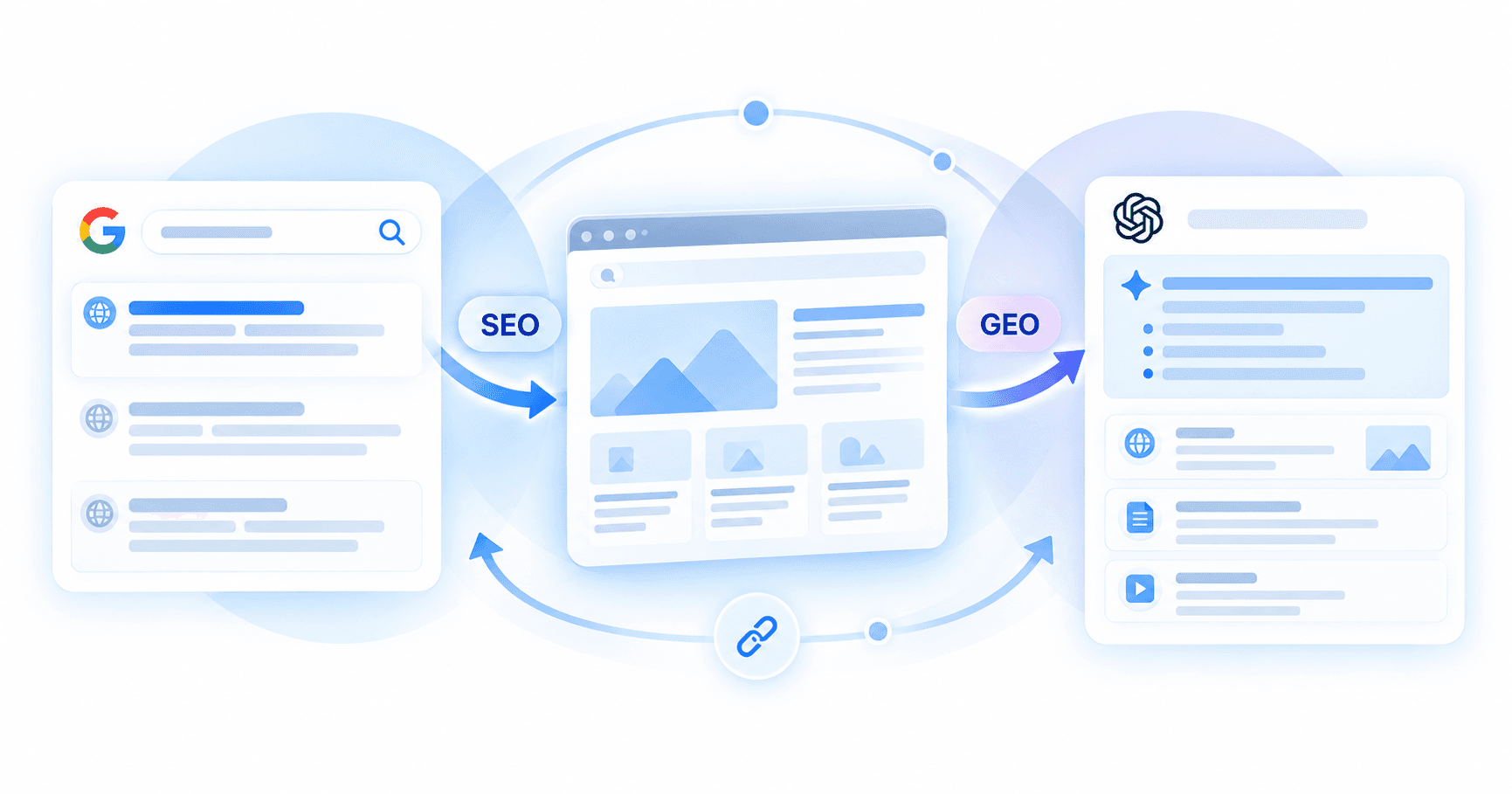
1) Search Engine Optimization (SEO), the foundation of traffic
Search remains the largest pipeline for organic traffic. Building a site structure that search engines can crawl and interpret properly is the foundation of every organic strategy. Content without a technical foundation may be published, but it will not truly enter the search market. You can review the full picture of SEO in What Is SEO? A Search Engine Optimization Guide from Fundamentals to Execution →.
2) Content, the fuel of traffic
The more content you build that aligns with search intent, the more search real estate you can occupy. What matters is not volume, but alignment. You need to design which keywords are covered by which content at each stage of the customer search journey (TOFU-MOFU-BOFU), so that every individual piece functions as a component of the funnel. We cover that design approach in the Content SEO column →.
3) GEO (Generative Engine Optimization), the expanded surface for traffic
As the center of gravity in search shifts toward AI-generated answers, the surface area of organic marketing is expanding beyond the search results page and into AI responses themselves. When your brand is mentioned or cited by answer-based services like ChatGPT or Perplexity, that represents one of the clearest forms of organic visibility that is difficult to build through advertising alone. That is because the candidates AI systems reference generally combine structured data, trust earned on search surfaces, and clearly attributable sourcing. GEO Optimization Strategy →

The Sequence for Designing Organic Marketing (Compound Traffic)
The most common mistake companies make after deciding to shift to organic is to start pushing out content immediately. Content without structure either does not get indexed, or, even if it does, overlapping intent causes pages to cannibalize each other’s rankings. The recommended sequence is as follows.
Step 1. Fix the technical foundation
: First, verify whether your site is in a state that search engines and AI systems can properly interpret. The main areas to check are indexing status, site architecture, and structured data.
Step 2. Design the keyword market
: Use data to understand the search market your business can realistically capture, and map content according to search intent. At this stage, you should also define the role of each piece so that keyword intent does not overlap across pages.
Step 3. Accumulate content assets
: Publish according to that map, and every time you publish, connect the new page to existing assets through internal links. Connected content gets indexed faster than isolated content and tends to hold rankings longer.
Step 4. Reinforce through data
: Use Search Console data to identify pages that are getting impressions but not clicks, as well as pages where rankings have stalled, and improve them. In organic, compounding happens more often through improving existing assets than through publishing net-new content.
This is not to say you should turn off ads immediately. The rational transition is to run both in parallel. While ads support short-term traffic, you build organic assets, and as organic traffic increases, you gradually reduce your dependency on ad budget.
Across the companies we have audited, the ones that adjusted budget mix over a 12-month period transitioned more successfully and more steadily than those that tried to cut ads all at once.
In the AI Era, the Value of Organic Only Increases
Finally, let’s address the timing question. Why organic now?
As AI search experiences move toward answer-based interfaces, more users may complete their decision-making within summary answers before ever reaching ad placements. In that environment, the influence of inventory you can buy only through advertising may become limited. By contrast, the sources AI draws from when generating answers are long-validated organic assets: structured websites and content that have steadily built trust over time.
Organic marketing is no longer simply “an alternative to save on ad spend.” In an era when AI determines which brands are presented as the answer, it is a critical ticket to becoming one of those candidates. We encourage you to examine how part of the marketing budget currently disappearing each month can be converted into assets, from the perspective of your traffic structure.
238LAB Insight +
When we examine the data of companies whose ad performance has plateaued, the issue is usually not ad operations skill—it is a traffic structure that depends only on ads. 238LAB designs compound traffic systems that accumulate through search and AI citation surfaces, so your marketing budget remains as an asset rather than disappearing as an expense.
FAQ
Q. What is organic marketing?
It refers to a traffic structure that brings customers to you through search visibility, content, and AI citations without paying media platforms for advertising. It is not free—it is a way of investing in accumulating assets instead of spending on disappearing ad inventory.
Q. How long does it take for organic marketing to produce results?
It depends on the state of the site and the level of competition, but in general, meaningful traffic curves begin to appear around 3~6 months after structural improvements, and then accelerate cumulatively. Unlike advertising, it does not start instantly, but it also does not disappear when you stop.
Q. Should we stop advertising and do only organic?
No. The practical approach is a parallel transition: build organic assets while ads support short-term traffic, then gradually reduce ad dependency in line with the growth of organic traffic.

About the Author
Aiden: SEO & GEO Consultant / Marketing
From venture investment to M&A advisory, I design digital growth across the entire corporate lifecycle. As an SEO consultant at 238lab, I focus on building sustainable, data-driven traffic structures. Former Marketing Lead at a venture and startup management consulting firm Former Digital Strategy Team Lead at a corporate finance advisory firm Current Head of Digital Strategy at 238lab