
Should similar keywords be covered in a single piece of content, or should each get its own page?
The key criterion here is not the number of keywords but search intent and the role of each page.
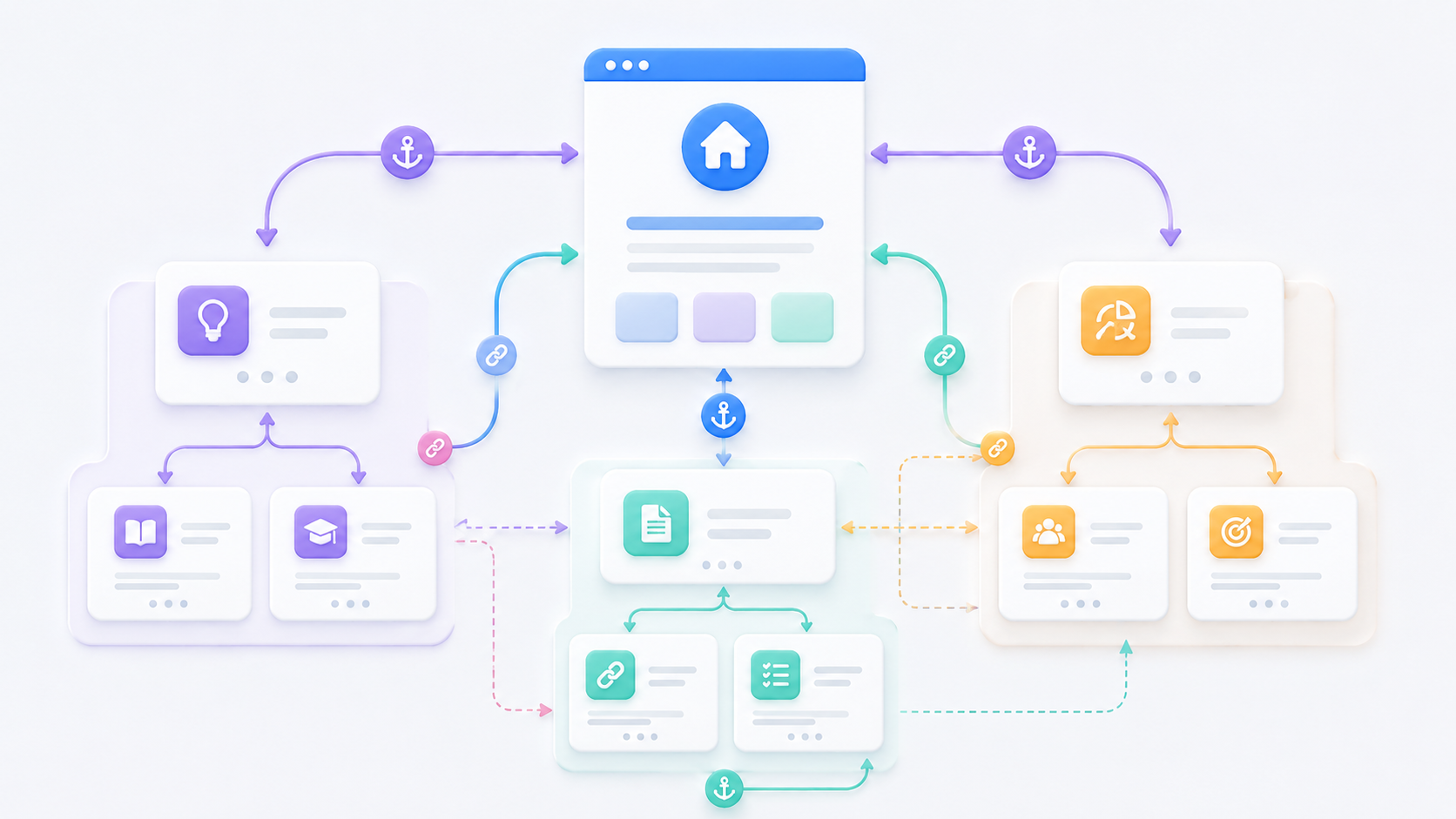
A topic cluster is an SEO content structure that organizes a pillar page and multiple cluster content pieces around one core topic, connecting them through internal links.
For example, suppose you set "website SEO" as a core topic.
You need a page that explains website SEO as a whole, but there are also subjects that deserve separate explanations — keyword research, technical SEO, meta tags, and internal linking.
In this case, the page that covers website SEO end to end becomes the pillar page, and each sub-topic becomes cluster content.
The structure looks like this:
- Pillar page: Website SEO
- Cluster content: Keyword research
- Cluster content: Technical SEO
- Cluster content: Meta tag optimization
- Cluster content: Internal linking strategy
- Cluster content: Content audit
What matters is not simply producing a lot of related content.
Each page must serve a different search intent while staying connected within a single topic.
Pillar Pages vs. Cluster Content
A pillar page is the central page that explains the overall structure of a topic.
If your pillar page covers "website SEO," a reader should be able to understand what website SEO is, what work it involves, and where to start — all on that one page.
Cluster content, on the other hand, goes deeper into specific questions that the pillar page cannot fully address.
The roles can be divided like this:
| Page role | Topic | Question it answers |
|---|---|---|
| Pillar page | Website SEO | What is website SEO and where do I start? |
| Cluster | Keyword research | Which search terms should become content topics? |
| Cluster | Technical SEO | How do I diagnose crawling and indexing issues? |
| Cluster | Meta tags | How do I write titles and meta descriptions? |
| Cluster | Internal links | On what basis should related pages be connected? |
| Cluster | Content audit | What are the criteria for keeping, merging, or revising existing content? |
A pillar page built as a mere "list of related posts" cannot function as the center of a topic cluster.
The pillar page itself must help users grasp the full context of the topic, then link out to cluster content wherever a more detailed explanation is needed.
Conversely, cluster content should not repeat what the pillar page already covers — it must fully resolve one specific search intent.
That is why you should not approach this as one page per keyword.
A single page typically covers one primary search intent along with the related questions needed to resolve it.
Topic Clustering vs. Keyword Clustering
Topic clustering and keyword clustering sound similar, but their purposes differ.
Keyword clustering groups multiple search terms into page-level sets based on search intent.
Topic clustering is closer to the process of implementing those groups as actual pages and internal link structures on your website.
For example, take these search terms:
- internal links
- internal linking strategy
- internal link optimization
- internal link anchor text
Judging by the words alone, they look like they could live on one page.
But to decide whether to consolidate pages, you need to check the search results.
Do users searching "what are internal links" and users searching "how to write internal link anchor text" want the same answer? Are the page types appearing in the search results similar?
If the search intents are close enough, one page can cover them. If independent search results and distinct tasks exist, separating them into dedicated cluster content is the better choice.
In short: keyword clustering decides "which search terms belong on the same page," while topic clustering designs "how those pages connect to each other."

How Is Topic Modeling Different from Topic Clustering?
Topic modeling is less a method for designing SEO content structure and more an analytical technique for discovering recurring themes in text data.
It is useful for finding repeated expressions or concerns in large volumes of unstructured text — reviews, VOC, consultation records, surveys, community posts.
Suppose these expressions keep appearing in reviews of a SaaS product:
- the pricing plans are confusing
- the pricing policy is hard to understand
- I don't know the free plan's limits
- it's hard to calculate the adoption cost
Topic modeling would classify these under one theme: "pricing and plans."
But discovering that theme does not mean you should immediately create one SEO page for it.
In actual search, the intent may split like this:
- product pricing comparison
- pricing policy
- implementation cost
- free plan limits
So after topic modeling surfaces a customer concern, you still need to collect search terms and verify the SERP and search intent.
To summarize:
| Method | Purpose | Main output |
|---|---|---|
| Topic modeling | Discover recurring concerns in data | Topic candidates |
| Keyword clustering | Classify search terms by intent | Keyword groups per page |
| Topic clustering | Design page roles and connections | Pillar, cluster, and internal link structure |
These are not substitutes for one another — they serve different stages of a content strategy.
Why Topic Clusters Help SEO
Building a topic cluster does not automatically raise your rankings.
The essence of a topic cluster is structuring one topic around multiple search intents and making the relationships between related pages explicit.
This improves SEO in three main ways.
1. You capture more search intents within a single topic
Even within one topic, user goals vary.
For example, the topic "content SEO" can include searches like:
- what is content SEO
- how to write SEO content
- content SEO checklist
- how to run a content audit
- fixing content cannibalization
- internal linking strategy for content
Covering all of these deeply on one page is difficult.
Creating a page for every search term, on the other hand, produces too much near-duplicate content.
So the broad concept lives on the pillar page, while questions that require independent resolution are split into cluster content.
This way you capture a range of specific search intents around the topic instead of depending on a single head keyword.
2. Search engines can discover the relationships between pages
Even if a site has plenty of related content, pages that exist in isolation may never reveal their relationships.
Internal links are one of the means of connecting them.
If your "content SEO" pillar page links to keyword research, search intent analysis, content audit, and internal linking pages, a structure emerges showing that each page belongs to the parent topic of content SEO.
Cluster content can also link back to the pillar page or to related detail pages where needed.
That said, connecting every page to every other page is not the goal of a topic cluster.
Internal links should be built around what the reader of the current content needs to see next.
3. It becomes easier to manage 404 pages and duplicate content
Designing a topic cluster requires first checking what role each existing piece of content plays.
In the process, you often discover orphaned 404 pages that receive no internal links, or duplicate pages targeting the same search intent.
Sites with a large content backlog frequently have multiple pages that differ only in title while effectively answering the same search question.
If you keep adding new content on top of these, the site structure only gets more tangled.
A topic cluster is a strategy for adding content — and at the same time, a content management practice that redefines the role of existing URLs.
What to Check Before Starting a Topic Cluster Strategy
Before building a topic cluster, decide which topic to structure first.
The keyword with the highest search volume does not have to be your first topic cluster.
Check the following together:
- Is the topic directly connected to the business?
- Can searches lead to actions such as inquiries, sign-ups, or purchases?
- Does content that already earns search traffic exist?
- Can you verify real search demand for the topic?
- Can user intent be clearly distinguished in the search results?
- Is the topic competitive against the content level of rival sites?
For a B2B service, a search term close to the consultation or evaluation stage can carry more business value even with modest monthly volume.
So rather than prioritizing topic clusters by search volume alone, weigh search demand and business contribution together.

Building an Inventory of Existing Content
Before planning new cluster content, organize your existing URLs.
At minimum, check the following:
| Item | What to check |
|---|---|
| URL | The current page address |
| Current topic | The question the page actually answers |
| Traffic queries | Search terms generating clicks |
| Impression queries | Search terms the engine associates with the page |
| Clicks / conversions | Current traffic and business contribution |
| Duplication risk | Whether search intent overlaps with another URL |
| Action | Keep, update, merge, or rewrite |
| Cluster role | Pillar or cluster content |
If the site already exists, make full use of Google Search Console data.
Estimated volumes from keyword tools matter, but Search Console shows which search terms your site actually appears for and which pages they send users to.
In particular, if similar search terms are spread across multiple URLs, review whether content roles are overlapping.
Intent-Based Keyword Clustering
Keyword clustering is not about collecting search terms that share similar words.
It is grouping search terms that want the same answer into a single page unit.
In practice, the process runs like this:
- Collect search terms related to the core topic.
- Review actual traffic and impression queries in Search Console.
- Classify the search intent of each term.
- Check the SERP for the main search terms directly.
- Compare the content formats and scope of the top results.
- Judge whether one page can resolve the question.
- Assign pillar page and cluster content roles.
For example, these search terms will likely be explained together on one page:
- what is a topic cluster
- topic cluster meaning
- topic cluster structure
All three carry a strong intent to understand the concept and structure of topic clusters.
These, on the other hand, may need separate content:
- how to build a topic cluster
- how to create a topic cluster map
- how to consolidate existing content into a topic cluster
The execution process, required data, and deliverables can all differ.
Which Keywords Belong on One Page?
If the following are similar, consider covering the terms on a single page first.
Search intent
Is the core problem the user wants to solve the same?
SERP makeup
Are the content types and scope in the search results similar?
Answer structure
Can everything be explained naturally within one outline?
The user's next step
After reading, do users want similar follow-up information?
Content overlap
If you split the pages, would they repeat largely the same material?
Conversely, if an independent SERP has formed, if separate examples, templates, or checklists are needed, or if the pages serve different conversion goals, consider standalone cluster content.
The purpose of splitting pages is not to inflate content count but to give each URL a clearly defined search intent.
How to Design a Pillar Page
A pillar page is the central content through which the entire core topic can be understood.
If "content SEO" is your pillar topic, one page should let readers grasp:
- the concept of content SEO
- why it matters
- its main components
- the basic execution process
- the related detailed SEO tasks
- the content where each detail can be explored further
The pillar page must be understandable on its own, with links to cluster content wherever deeper explanation is needed.
That is why setting a fixed word count for pillar pages is not appropriate.
Scope it to explain the topic sufficiently while avoiding unnecessary overlap with the detail content.
How to Design Cluster Content
Cluster content handles independent search intents that the pillar page cannot cover in depth.
Under "content SEO," for example, you might build clusters like:
- SEO keyword research methods
- how to analyze search intent
- how to run a content audit
- diagnosing keyword cannibalization
- internal linking strategy
Each piece must provide enough of an answer to earn search traffic on its own.
Again, you do not need a piece of content for every keyword.
An "internal linking strategy" article can cover internal link structure, anchor text, orphan pages, and link auditing together.
But if a sub-question shows independent search intent and sufficient demand, it can be expanded into its own cluster content.
Reorganizing Existing Content into a Topic Cluster
If you already run a large content library, sort out the roles of existing URLs before creating new pages.
Check these situations in particular.
Multiple URLs serving the same search intent
If the body content and traffic queries overlap substantially, choose a canonical URL and consider consolidation.
Similar topics but different intents
Keep the pages, but clearly separate the search intent each one serves.
For instance, "topic cluster meaning" and "how to build a topic cluster" belong to the same topic but may serve different goals.
Low-value duplicate URLs
If a representative page is clear and the old URL no longer needs to exist, consider a 301 redirect.
Multiple technically similar URLs
For near-duplicate URLs whose page purpose is identical, consider canonical tags.
Note that canonical tags are not a tool for resolving content conflicts between pages with different intents.
If search intents overlap, fix the content and URL roles first.
Designing Internal Links Within a Topic Cluster
In a topic cluster, internal links are not merely devices for tying pages together.
They are a navigation structure that helps users find the next thing they need after resolving their current question.

Linking from the pillar page to cluster content
On the pillar page, link to the relevant cluster content at the points where detail is needed.
For example, after briefly explaining how to manage existing content on a content SEO pillar:
"To check whether your existing content overlaps in search intent, see the URL-by-URL review criteria in how to run a content audit."
This gives users a clear reason to click, unlike a bare list of related posts at the bottom of the page.
Linking from cluster content to the pillar page
In cluster content, link to the pillar page where readers may need to see how the detailed task fits into the overall strategy.
While explaining how to write internal links, for instance, you can link to the topic cluster or content SEO pillar when the full content structure needs review.
There is no need to link to the pillar repeatedly in every paragraph.
Place the link naturally where users actually need the parent concept.
Linking between cluster content
Cluster-to-cluster links should not be added just because two pages share a topic.
If your keyword research article explains classifying collected search terms into page groups, linking to the "intent-based keyword clustering" article makes sense.
But connecting unrelated pages merely because they belong to the same cluster complicates the user's navigation flow.
Writing anchor text
Anchor text alone should let readers predict what they will find on the destination page.
Instead of "here," "read more," or "click," describe the destination:
- how to write internal link anchor text
- how to audit 404 pages
- content audit checklist
- how to diagnose keyword cannibalization
You do not need to repeat identical anchor text mechanically across every page.
Phrase it naturally within the sentence while keeping the destination's topic unmistakable.
Structures to Avoid in a Topic Cluster
There are common failure patterns when building topic clusters.
Linking every page to every other page
More internal links do not make a better topic cluster.
When links unrelated to the user's next question pile up, each page's role becomes blurry.
Creating a page per keyword
Making content for every variant phrasing multiplies near-duplicate content and raises the risk of keyword cannibalization.
Pillar pages that are just link lists
If the pillar page cannot sufficiently explain the core topic itself, it offers no independent value to search users.
Publishing new posts without auditing existing content
A page serving the same search intent may already exist.
Check the traffic queries and role of existing URLs before deciding to publish new content.
Measuring Topic Cluster SEO Performance
The performance of a topic cluster is hard to judge by the ranking of a single page.
Check whether search visibility is expanding across the cluster as a whole.
| Area | Metrics |
|---|---|
| Search visibility | Total impressions, non-brand impressions, number of impression queries |
| Traffic | Clicks, CTR, traffic by landing page |
| Rankings | Average position for pillar and key cluster queries |
| Indexing | Indexed URLs, excluded URLs, crawl errors |
| Structure | 404 pages, missing internal links, broken links |
| Business | Inquiries, sign-ups, purchases, leads, and other conversions |
Early on, cluster content may start appearing for long-tail queries the site never ranked for.
From there, watch whether clicks, rankings, and conversions on the key pages improve together.

Topic Cluster FAQ
1. What is the difference between topic clusters and keyword clustering?
Keyword clustering classifies search terms into page-level groups based on search intent and SERP similarity.
A topic cluster is the SEO content structure that organizes those pages into a pillar page and cluster content connected by internal links.
2. How long should a pillar page be?
There is no fixed word count.
Provide enough to understand the core topic, and link to cluster content for sub-questions that need standalone explanations.
What matters is not length but whether the roles of the pillar page and the detail content are clearly separated.
3. How many cluster content pieces are appropriate?
That depends on how many sub-questions carry independent search intent, the search demand, and business priority.
Forcing similar search terms apart into multiple pages creates duplicate content and keyword cannibalization.
4. Can a category page serve as a pillar page?
It can, depending on how the page is built.
A category page that simply lists recent or related posts is closer to a navigation page.
But if it explains a topic comprehensively and links to the relevant detail content in context, it can function as a pillar page.
5. How is topic modeling used in an SEO content strategy?
Topic modeling helps find recurring concerns and problems in reviews, VOC, consultation records, and survey responses.
Rather than turning those themes directly into SEO content, verify the actual search terms, demand, and SERPs first, then use them as content candidates.
The Order of Building a Topic Cluster
If this is your first topic cluster, design the structure around one core topic rather than reworking the whole site at once.
The execution sequence:
- Select a core topic connected to the business.
- Collect the existing URLs related to that topic.
- Review traffic and impression queries in Search Console.
- Classify the search terms by intent.
- Check the actual SERPs to set merge/split criteria for pages.
- Assign pillar page and cluster content roles.
- Decide whether to keep, update, or merge existing content.
- Design the internal links between the pillar and clusters.
- Audit indexing, orphan pages, and duplicate URLs.
- Measure changes in search visibility and conversions at the cluster level.
If content with established search traffic and backlinks already exists, expanding that page can beat creating a new pillar URL.
The goal of topic cluster SEO is not to produce more content.
The core is separating user search intents into distinct pages within one topic, and clearly designing the role and relationships of each page.
It does not end with collecting search terms — you must decide which questions one page will resolve and which questions deserve standalone content.
When those decisions are reflected in the pillar page, the cluster content, and the internal link structure, the topic cluster works as a real SEO content architecture.

About the Author
Aiden: SEO & GEO Consultant / Marketing
From venture investment to M&A advisory, I design digital growth across the entire corporate lifecycle. As an SEO consultant at 238lab, I focus on building sustainable, data-driven traffic structures. Former Marketing Lead at a venture and startup management consulting firm Former Digital Strategy Team Lead at a corporate finance advisory firm Current Head of Digital Strategy at 238lab