

Building a website as a SPA (Single Page Application) greatly improves the user experience. Pages transition smoothly with a single click, and there are no unnecessary refreshes.
However, this SPA approach has some tricky aspects when it comes to SEO, or search engine optimization. Search engines evaluate a site based on the content contained in the HTML. But a SPA has almost no actual content in the HTML at the initial loading point and then builds the screen with JavaScript afterward. Because of this, search engines like Google or Naver (Korea's dominant search engine) sometimes fail to recognize the site properly.
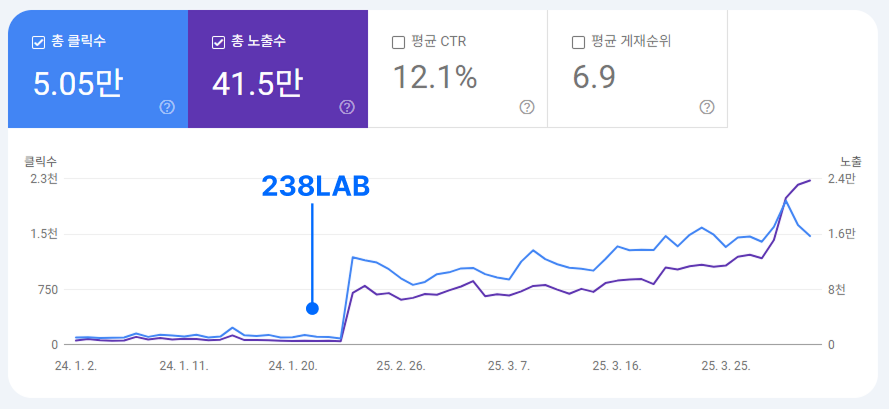
With advertising costs rising ever higher these days, properly implementing SEO can secure a steady stream of substantial traffic without separate advertising costs, depending on company size. That is why quite a few IT platforms developed in SPA environments are quietly adopting SEO.
So today, we will organize the available methods for doing SEO well when you have built a site in the SPA style, and what to consider for each.
Why is the SPA approach disadvantageous for SEO?
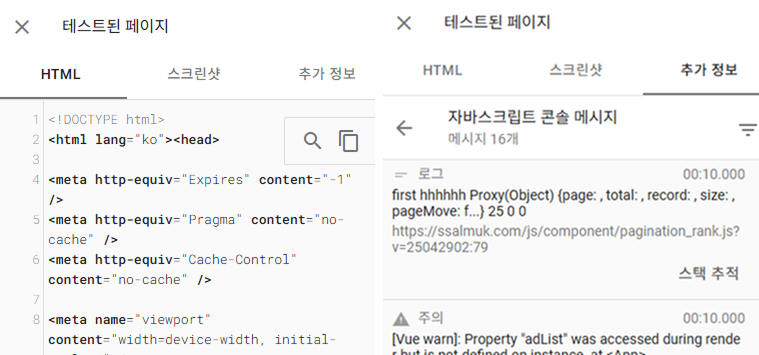
A SPA initially delivers only the HTML, and the rest is built in the browser with JavaScript. As a result, when the Google bot visits and crawls the site, it may determine that "there is no content."
In particular, even though it may appear to have multiple pages, it actually operates within a single HTML, making page-by-page indexing difficult. This kind of structure can work against search visibility.
Looking at Google search trends as of 2025, with the establishment of mobile-first indexing and improvements in JavaScript crawling technology, SPAs can also be sufficiently exposed to search engines. However, the limitations of the Google bot and crawl budget issues still remain. If even the leader, Google, is at this level, you can imagine Naver is even more difficult.
To improve SEO performance in this environment, what matters is not vague expectation but providing appropriate HTML 'at the moment the crawling bot visits' so that the SEO tag values of a specific page are read accurately.
3 ways to implement SEO in a SPA development environment
To implement SEO successfully, you must consider the following 3 elements as core:
- Crawlability: All URLs must be accessible to search engines.
- Content accessibility: Key content must be exposed even without JS execution.
- Perceived performance: A fast loading experience must be provided to both users and bots.
The methods that can address these core elements are currently the three: SSR, SSG, and Dynamic Rendering.
| Method | Description | Pros | Cons | Suitable for |
|---|---|---|---|---|
| SSR (Server-Side Rendering) | Generates HTML on the server with each request | Provides complete HTML to crawlers; fast initial content exposure | High server load; complex implementation | Large commerce; real-time content sites |
| SSG (Static Site Generation) | Generates HTML in advance at build time | Fast response speed; caching optimization | Difficult real-time reflection; management burden when there are many pages | Blogs, documentation sites, and other cases with few updates |
| Dynamic Rendering (Prerendering) | Provides HTML only to crawlers, SPA to users | Can be applied quickly, with minimal changes to existing code | Not recommended by Google; complex maintenance | Temporary stopgap before SSR adoption |
As the table above shows, SSR provides the most reliable SEO effect, but development and operating costs are high. In return, it can respond to all crawlers and, beyond Google, guarantees content exposure even to search engines with low rendering capability such as Bing.
SSG is the method that provides the best ROI when conditions are right. A static page built once provides the fastest experience not only to the Google bot but also to users, improving SEO and UX at the same time. Looking only at the output, it may be the best method. However, in services that frequently require content updates, applying SSG across the board can be difficult, so careful consideration is needed.

Hybrid techniques such as Next.js's ISR (Incremental Static Regeneration) have also emerged. Dynamic Rendering (prerender) is a method Google proposed in the past as a workaround for SPA SEO. However, according to the official Google guide since 2022, the dynamic rendering method is no longer officially recommended, and the documentation was revised to describe it as "a temporary workaround to be used only as a last resort."
To put the conclusion first, the final destination of a site built in the SPA style is very likely to be SSR (Server-Side Rendering).
Of course, the cost of attaching a prerendering service like Prerender.io is lower than SSR, so the short-term ROI may be acceptable. However, in the long term, it is highly likely to become technical debt. Ultimately, you must examine available resources and strategically choose between SSR, SSG, and prerendering.
You can also consider a partial SSR strategy that applies SSR/SSG with priority to the key pages important to crawlers (e.g., product lists, detail pages), while leaving frequently changing parts as client rendering. This hybrid rendering approach is a realistic way to balance SEO effect and development cost.
SEO for the React framework
A SPA built with React operates by default with client-side rendering (CSR), so you need to consider additional strategies for SEO.

First, the most widely used method is adopting SSR/SSG through Next.js. Next.js is an SSR framework for React that makes it easy to implement page-level SSR and static generation. It provides completed HTML to crawlers, and operates as a SPA in the browser through hydration.
Adopting Next.js also helps improve Core Web Vitals, as image optimization, code splitting, and more are applied automatically. In fact, many global services such as Notion and Hulu have migrated to Next.js to improve SEO traffic and performance.

If you have a React site centered on static content, you can consider a React static site generator (SSG) such as Gatsby. Gatsby generates all pages as HTML at build time and deploys them, so you can achieve fast page loading and excellent SEO metrics.
However**, Gatsby has aspects that make it realistically difficult to apply to services where data changes frequently**. Therefore, it is suitable for cases where content does not change often, such as blogs or newsletter sites.
Finally, if resources are truly scarce and it is difficult to adopt Next.js or Gatsby, there are cases where you partially apply post-build static prerendering with prerender-spa-plugin, or attach a service like Prerender.io via server middleware to respond to dynamic crawling for only some pages.
For example, cases have been reported of taking a landing page originally built with CSR and serving it statically only to crawlers via Prerender.io to boost search traffic. However, as mentioned earlier, it is best to use such methods only as a stopgap.
SEO for the Vue framework
In a Vue.js-based SPA, Nuxt.js is effectively the standard SEO solution. Nuxt.js is Vue's SSR/SSG framework, which simplifies server-side rendering so that developers can easily handle SEO.

In fact, this part is the key. When you use Nuxt, pages written as Vue components are pre-rendered on the server and sent, so the Google bot crawls content directly without ever seeing an empty page. Nuxt can also be built in static mode and used like SSG, so you can flexibly choose between SSR and SSG to fit the nature of the project.
There are many cases where organic traffic increased significantly after converting an existing Vue SPA to Nuxt. In particular, Vue apps where SEO is important, such as e-commerce and media sites, are expected to have high ROI from adopting Nuxt.
Nonetheless, if you must apply SEO to an existing Vue SPA without Nuxt, similar to the React case, you would consider pre-rendering via prerender-spa-plugin as an alternative. Unlike React, applying this plugin to the output built with Vue CLI lets you generate static HTML snapshots for the routes you designate.

In consulting practice, there are occasional cases of creating URLs that use the # hash. In this case, using History mode in Vue Router lets you create a clean URL structure. Hashbang URLs in the /#/ form are disadvantageous for SEO, so be sure to avoid them.
SEO for the Angular framework
Compared with the React and Vue frameworks, Angular requires a relatively lower total amount of resources to implement SEO. It is a framework built structurally to consider both SPA and SSR support, and it provides an official SSR solution called Angular Universal.
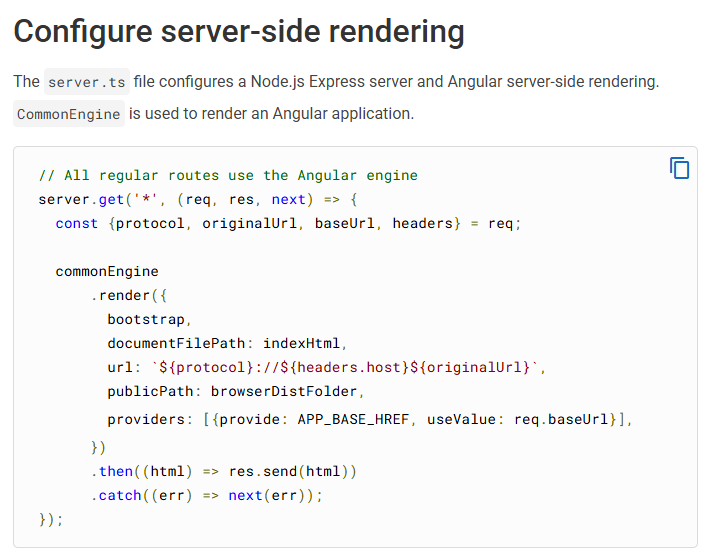
For details, it is best to refer to the official Angular Universal documentation. Using this solution, you can render an Angular application in a Node.js environment to output HTML. When you apply Angular Universal, server-rendered HTML is provided at the app's initial load, and afterward Angular takes over operation on the client (hydration).
Angular has a prerender feature built in, so you can generate static HTML per route at build time. By using the ng prerender configuration in the Angular CLI, you can statically save and deploy the SSR results for designated paths. This way, you can enjoy the SSG effect without the server load of SSR. However, data that changes after build time is not reflected, so it is best to use this for pages centered on static content.
As a practical tip, when setting up an SSR solution, you should dynamically set meta tags using the Meta service on the server side, and reliably handle URL changes during page transitions in the RouterModule. Ultimately, SEO is a battle over how you assign uniqueness to URLs for differentiation, so it is good to look carefully at this part.
Wrap-up: things to consider when applying this in practice
Finally, based on what we discussed earlier, let me organize the strategy choices and priorities for improving SPA SEO in practice. When you comprehensively review return on investment (ROI), implementation difficulty, and SEO impact, it is best to approach in the following order.
1. Check crawling/indexing
First, you must determine whether the site's core content is being indexed by search engines. If budget and difficulty allow, the key is to prioritize adopting SSR or SSG above all. If you have budget constraints, consider introducing SSR/prerendering starting with key landing pages, but as Google officially recommends, use dynamic rendering only as a last resort and plan to remove it in the long term.
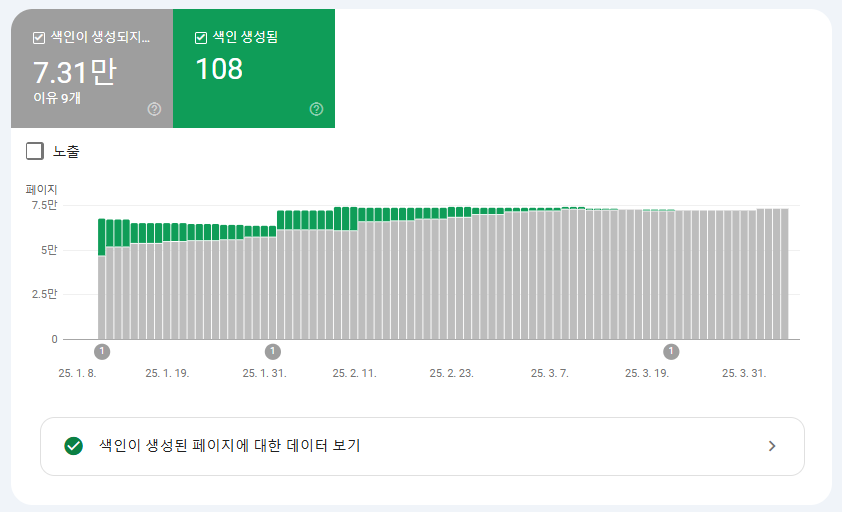
When prerendering and the like is used, in the worst case a situation like the one above can occur where the number of indexed pages decreases. Therefore, be sure to first determine crawling/indexing status, introduce prerendering to some of several similar pages first, and then apply it to all - this order is more efficient in terms of ROI as well. For a new project, it is even better to adopt a framework such as Next.js, Nuxt.js, or Angular Universal from the start.
2. Site structure and URL optimization
Typically, if you have cleared step 1 well, the next step is to improve rankings through site structure and URL optimization. SPAs have their own characteristic URL structure, so the process of improving this to be SEO-friendly is essential.
Set a routing strategy so that each page has a unique URL with a meaningful path. For example, implement it based on the History API (pushState) rather than hash (#) based, to create URLs that "look like pages," and generate a sitemap (XML) to submit to search engines. Also check on-page SEO elements such as canonical tags for duplicate content and meta robots tag management.
Once this step is completed without issues, a basic crawling and indexing environment is secured.
3. Improving exposure performance (ranking improvement)
There is something I always emphasize when conducting consulting. Rather than tracking rankings 'on a per-page basis,' setting 'the average exposure ranking of the key indexed pages' as the core KPI is more suitable for SEO performance management.
Typically, after completing step 2, you enter the process of raising the overall site authority through establishing a structured tag system, keyword strategy, content automation strategy, and so on. Just reaching this point can effectively be a stage where you are seeing considerable results from SEO.
If you approach with these 3 as priorities, you can obtain the maximum SEO improvement relative to your resource investment. In summary, it is best to execute step by step in the order "content exposure → structure improvement → exposure optimization."
In actual practice as well, the common pattern is to solve indexing issues by adopting SSR/staticization, then boost rankings through performance tuning. Ultimately, what matters is choosing the optimal combination of strategies to fit the scale and purpose of your own service.
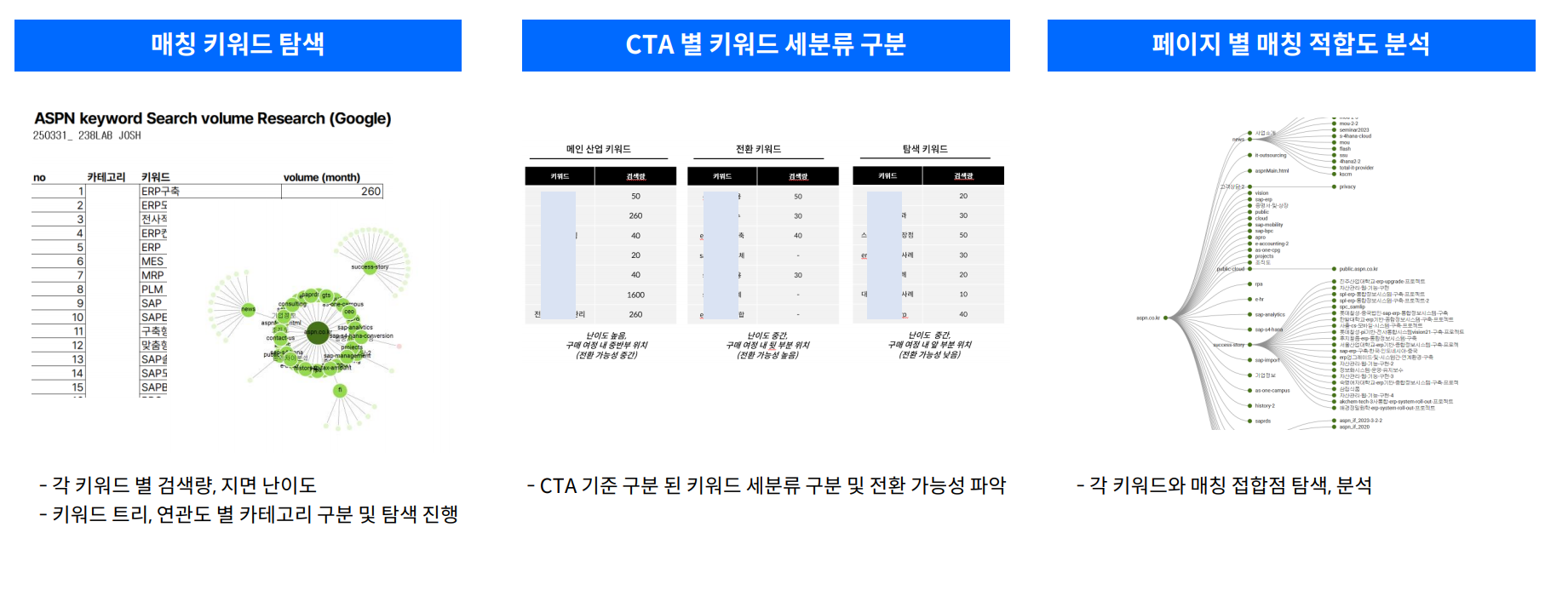
To create more aggressive results, it is best to review more elements, from keyword clusters to TF-IDF. When carrying out a project, considerable resources are already invested just in adopting SSR, so for the other parts, it is common to establish and apply an overall structural guide together with a consultant. This has the advantage of enabling a more solid SEO implementation.
238LAB also has cases where we carried out a substantial number of SPA environment projects and produced results. If you are interested, consulting with a consultant is also a good approach.

About the Author
Joshua: Lead SEO Consultant
- Built a zero-cost structure generating KRW 1.2 billion in annual revenue through SEO alone - Closed a KRW 700 billion deal through SEO alone - Low-cost, high-efficiency marketing specialist Former) Marketing Lead at a financial services firm Current) Runs SEO/GEO agency 238lab Track record) Led multiple SEO consulting projects, including Korea's No.1 AI community