
"We changed the title and reinforced the content, but rankings still aren't moving." It's something we hear often in SEO consulting sessions. If you've done everything that can be improved inside the website and rankings still won't budge, the cause may lie in external factors.
There are many external factors, but the one search engines weigh most heavily is backlinks. Search engines evaluate not only a page's content but also how much other websites cite that page. Use this article to audit your own site's backlinks — and to see which parts you can manage yourself and which parts call for a professional diagnosis.
What Is a Backlink?
So is a backlink just any link to your site placed on another site? The short answer is no.
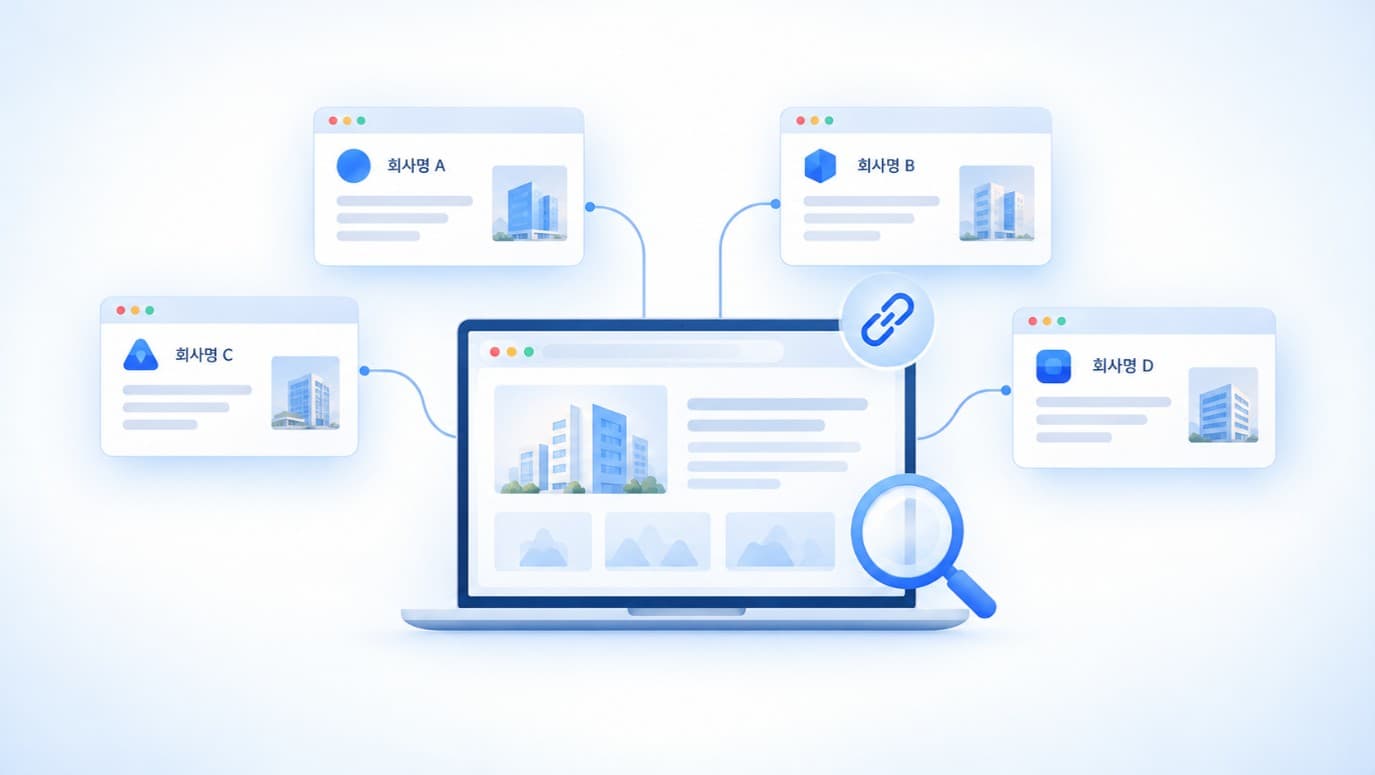
A backlink is a link another website creates when it cites or introduces your page — for example, an industry publication citing your research in an article with a source link, or a partner company linking to your service page while describing a collaboration.
The key is "who linked, and why." Search engines look less at the fact that a link exists and more at which site linked in what context. A link placed voluntarily because your page was worth referencing and a link that is merely a pasted URL are not evaluated as the same backlink.
Why Search Engines Examine Backlinks
It's just one link on another site — why would it move your search rankings?
A search engine cannot judge how much to trust a page from its content alone. Anyone can write "we're the best" on their own page. So search engines look for evidence outside the site. If another site cited and linked to the page, then at minimum that site judged the page worth referencing.
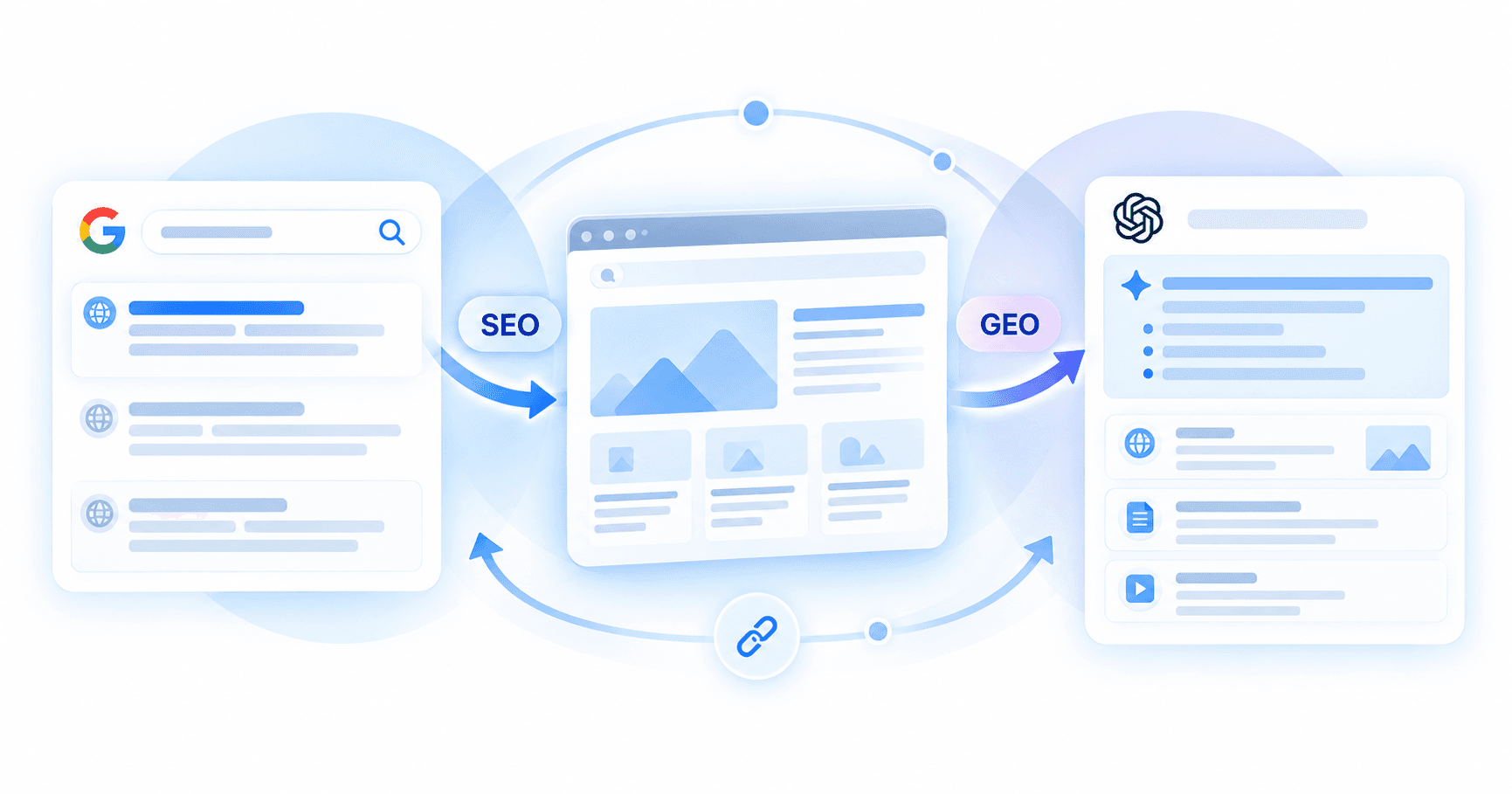
On-page SEO is information you organize yourself, but a backlink is evidence that another site has recognized your page. Because it's a signal you cannot manufacture at will, search engines treat it as more trustworthy. Google's early ranking algorithm, PageRank, started from this very principle, and backlinks are still known to be one of the main grounds for evaluating trustworthiness.
That said, the weight differs depending on which site did the recognizing. Search engines evaluate not the number of links but which site sent the link and in what context it was placed. Growing link counts without understanding these criteria yields no effect — or can even backfire.
Will Search Engines Actually Count My Links?
So how much value does your website hold inside Google — and how much are the links pointing to your site actually raising that value?
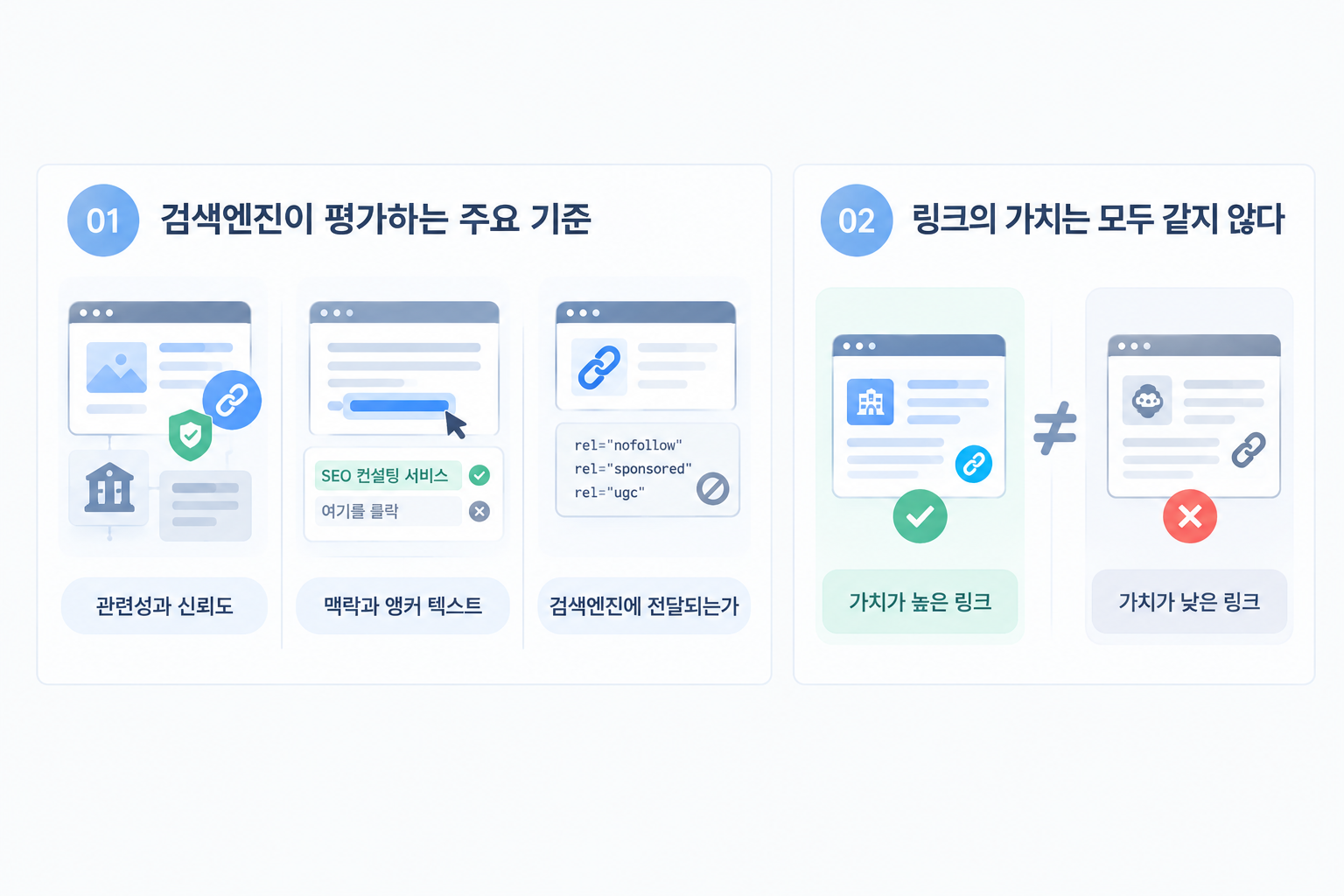
A backlink's value depends on the site that placed it and how it was placed. The criteria search engines are known to consider when evaluating a link are as follows.
Relevance and Trustworthiness
A link to an SEO service page from a marketing publication and one from a cooking blog are not the same link. Search engines look at whether the linking site's topic relates to your page, and how much that site itself is referenced elsewhere. A single link from a respected publication or institution in your field can have more impact than dozens of links from low-trust sites.
Context and Anchor Text
A link woven naturally into body text while explaining something is evaluated differently from links inserted in bulk into footers or sidebars. The wording of the link (anchor text) also matters: a phrase that describes the destination, like "SEO consulting services," sends a clearer signal to search engines than "click here." But if the same phrase repeats unnaturally, it can be judged as manipulation.
Does It Reach the Search Engine?
If a link carries the nofollow, sponsored, or ugc attribute, search engines either don't factor it directly into trust evaluation or use it only as a reference. Paid placements and links in comments or community posts mostly carry these attributes. These are the cases where a link exists but has no effect on rankings.
| Criterion | Valuable links | Low-value or uncounted links |
|---|---|---|
| Who | Publications, institutions, and partners in your field | Sites unrelated to your topic or with low trust |
| How | Linked within body text while explaining content | Bulk footer/sidebar insertion, unnatural repeated phrases |
| Attributes | Standard links | nofollow, sponsored, ugc |
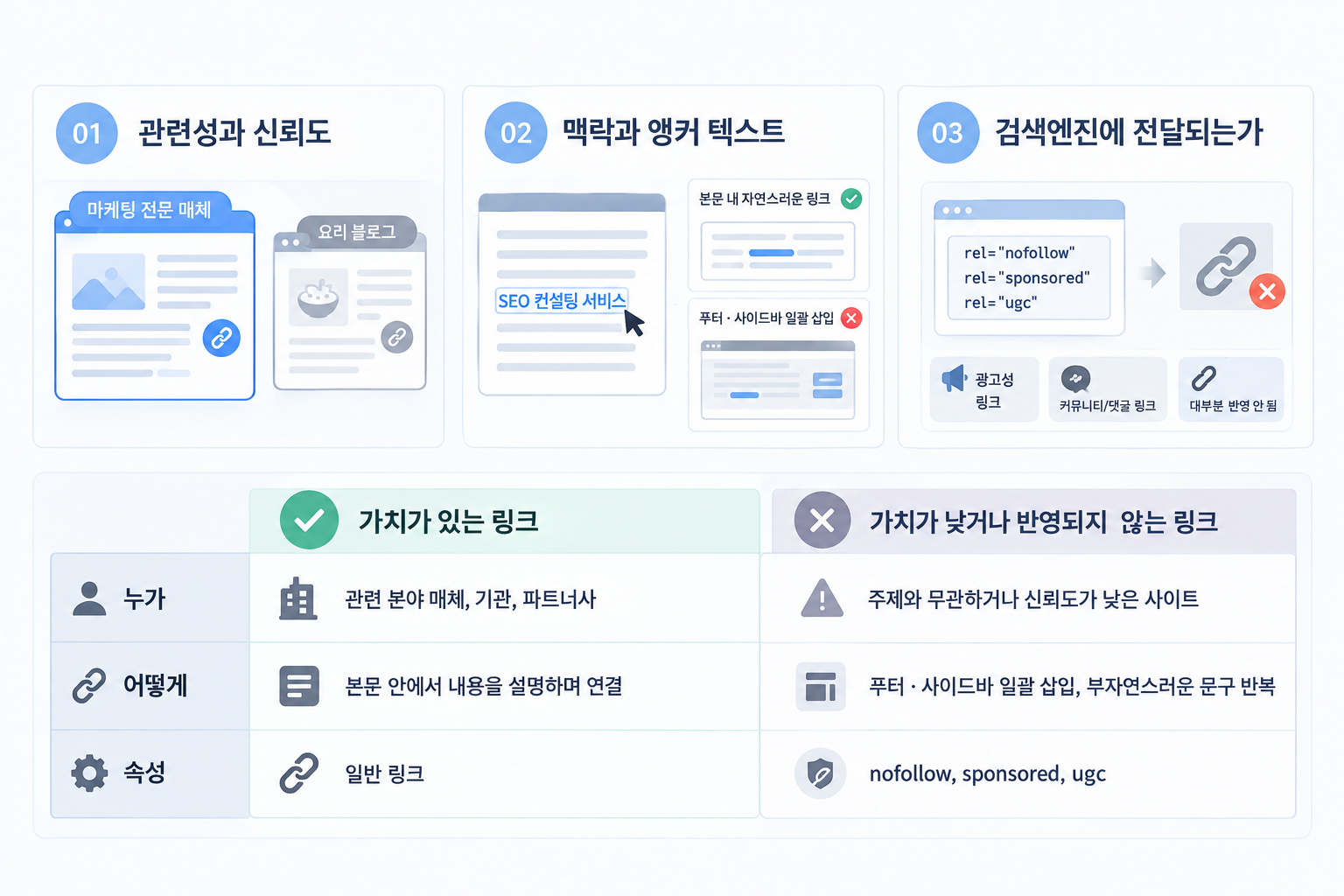
Which side of these criteria your site's links fall on is hard to judge from a list of links alone. It only becomes clear once you check the trustworthiness and attributes of each linking site, one by one.
Is My Content Something People Want to Cite?
You cannot create backlinks yourself. They only come into being when another site's operator has a reason to link to your page from their own content. Acquisition therefore starts not with "asking for links" but with "creating reasons to link." In practice, links get created through three main routes.
Create Citation-Worthy Material
Sites usually link to give their readers evidence or reference material: research summarizing market conditions, guides walking through how to solve a specific problem, case studies showing real results.
A page introducing your service is hard to cite, but a page organizing the data or methodology behind that service can be. The starting point is figuring out what kind of material is missing in your field, and what content your competitors are earning links with.
Leverage Partner and Media Relationships
Publishing an expert column in an industry outlet or giving an interview gets your site introduced along with your affiliation. Publishing a collaboration case study with a client or partner links both sites to each other.
Member listings of associations and institutions, and records of event participation, can also become trustworthy links. This is a route where links come from relationships rather than content, and it tends to carry particular weight for B2B companies.
Turn Unlinked Mentions into Links
Sometimes your brand or material is mentioned somewhere without a link — a publication citing your research with an attribution but omitting the link, for instance. Finding these mentions and requesting a source link is a relatively easy way to secure links. You can find them by searching your brand or material names, or by using mention-monitoring tools.
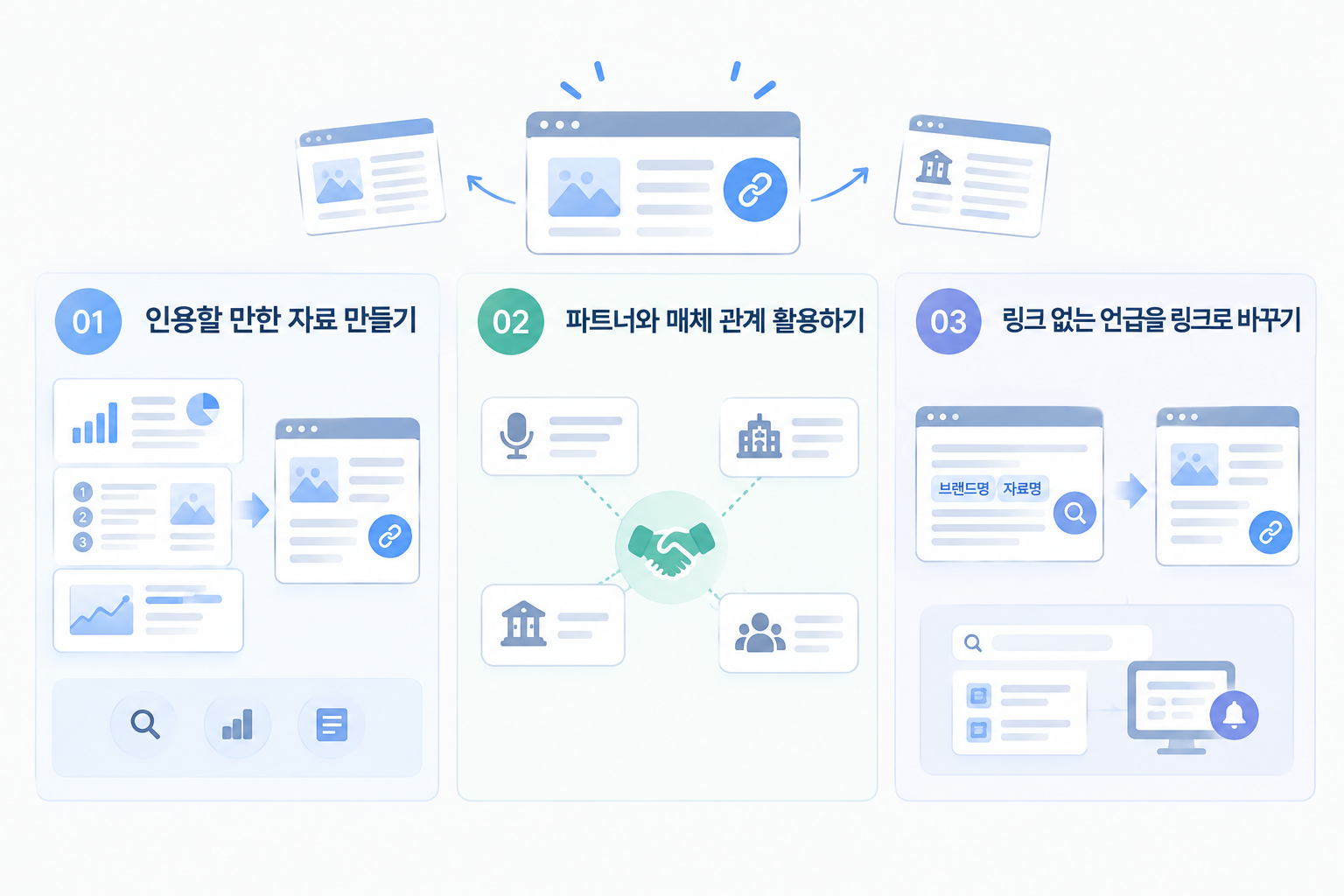
None of these three methods produces results quickly.
It takes time for citation-worthy material to accumulate and become known. Which content will attract links, and which publications and partners carry trust in your field, can only be learned by analyzing competitors' backlinks.
Can't I Just Buy Them?
Many companies actually did, and plenty of managers still get pitched such services today. The short answer: Google defines links created to manipulate rankings as link spam, and states that it may lower the site's rankings or remove it from search results.
The typical methods are:
- Link buying: paying for links
- Bulk link exchanges: agreeing to link to each other, connecting unrelated sites
- Automated link generation: mass-registering links in comments, forums, and directories with software
- Private blog networks (PBNs): building sites that exist solely to send links, then connecting them
These methods can increase link counts in the short term. The problem is that the moment a search engine identifies the pattern, you can lose the rankings you built along with it. Once penalized, you have to clean up the offending links and request reconsideration, and recovery often takes a long time.
In particular, if you ever ran link campaigns through an outside vendor, spam backlinks from sites built purely to send links — PBNs and the like — may still be accumulated against your site today. The more of these links you have, the lower your site's overall evaluation can sink.
In that case, you need a full backlink review to identify and remove links from low-authority domains or those judged as spam. Which links to remove and which to keep can only be determined by analyzing each linking site individually.
What you trade for short-term rankings is your site's trust — and trust is hard to buy back.
Self-Check and In-Depth Diagnosis
A manufacturing company manager opened their link report for the first time during a consulting session. The site sending the most links to their website was neither an industry publication nor a partner — it was an obscure overseas directory site they had never heard of. Meanwhile, the service pages responsible for actual revenue had not a single link.
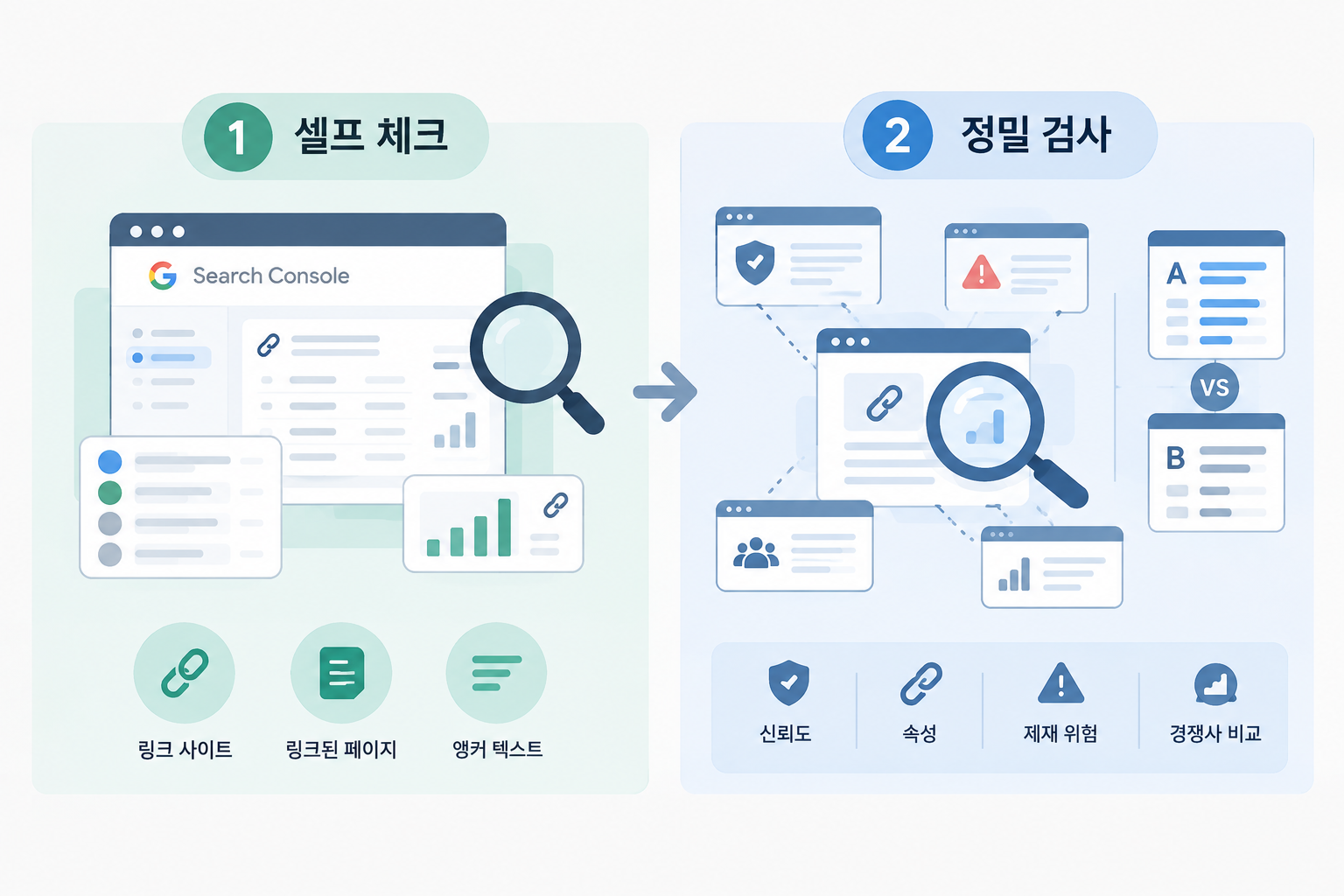
It's a moment much like facing an unexpected number in a health checkup for the first time. Your site's link profile may not be much different. The check comes in two stages.
Self-Check
You can see which links point to your site in Google Search Console's Links report: which sites link to you, which pages are linked most, and with what phrases. Like a thermometer or blood-pressure monitor, these are numbers anyone can read immediately. Start by checking the top linking sites and your most-linked pages in this report.
In-Depth Diagnosis
What a self-check tells you ends at "where the links came from." Search Console shows only a portion of the links Google has recognized, and it doesn't indicate whether each link is valuable under the criteria above or carries penalty risk. It also doesn't show which sites your competitors are getting links from.
Only by checking each linking site's trustworthiness and attributes, and comparing your link profile against the sites competing for the same queries, does your site's true position come into view.
Closing
A backlink is a link another site places while citing your page, and search engines use it as evidence for judging trustworthiness. The backlinks that work are those connected naturally within body-text context from relevant, trustworthy sites — and they are created through citation-worthy material and relationships in your field.
Checking your current link status in Search Console is something you can do yourself. But whether those links are actually being counted, whether penalty-risk links are mixed in, and which links you lack compared to competitors are questions that require analysis tools and interpretive experience. If you're finding it hard to determine whether stalled rankings on your target queries come down to backlinks, consider reviewing your backlink profile and overall off-page SEO through 238LAB's SEO consulting. We benchmark competitors' backlink profiles and map out which links are attainable in your field, in priority order.

About the Author
Aiden: SEO & GEO Consultant / Marketing
From venture investment to M&A advisory, I design digital growth across the entire corporate lifecycle. As an SEO consultant at 238lab, I focus on building sustainable, data-driven traffic structures. Former Marketing Lead at a venture and startup management consulting firm Former Digital Strategy Team Lead at a corporate finance advisory firm Current Head of Digital Strategy at 238lab