
The recently published research by Rand Fishkin changes how most marketers have viewed AI search (GEO).
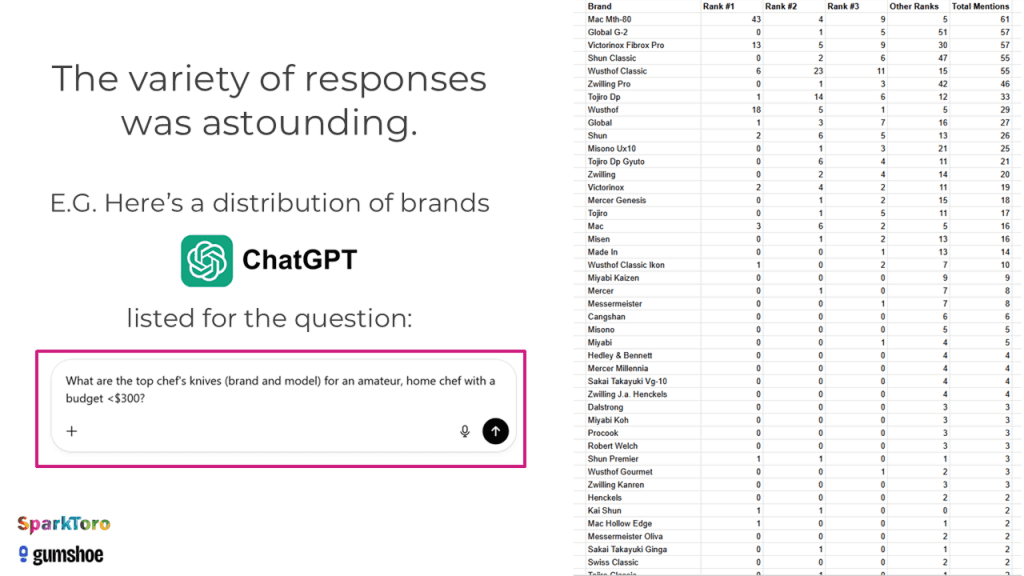
Here is the conclusion first. The probability that AI engines like ChatGPT or Claude answer the same question with the same ranking is under 0.1%. The core finding: tracking 'rankings' the same way you would in Google SEO is chasing meaningless noise.
Rankings Matter Less and Less in GEO
Many marketers still ask, "What position does our brand show up in within AI answers?" But this is a performance metric born from a failure to understand how the technology works. AI does not output a database in sequence. It is a 'generative' engine that constructs sentences anew, by probability, every single time.
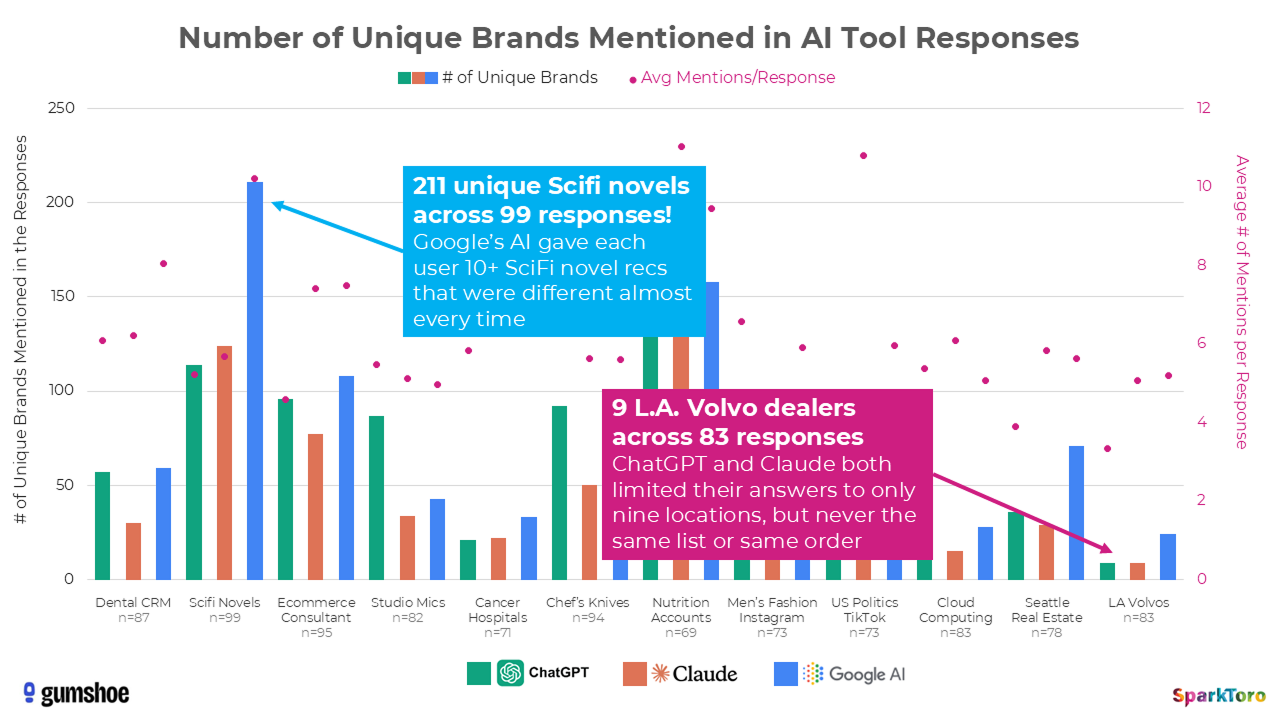
In this experiment, across 3,000 tests, the composition and order of recommendation lists almost never matched. Even the number of items in the list varied each time. If an agency claims it can guarantee AI search rankings with proprietary technology, it most likely does not understand how AI works, or it is dressing up its business with deception.
The Marketer's New Metric: Mention Frequency
The only measurable reality in GEO is mention frequency. Rankings vary with every question, from 1st to 10th, down to the number of items on the list. Yet some brands still get mentioned 9 times out of 10.
Rankings may be random, but mention frequency proves which brands AI classifies as 'trustworthy options.' Ultimately, the core of GEO is not the technical skill of placing a brand at a specific rank. It is securing the sheer volume of data that makes AI recognize your brand as a 'constant that must be cited' after tens of thousands of probability calculations.
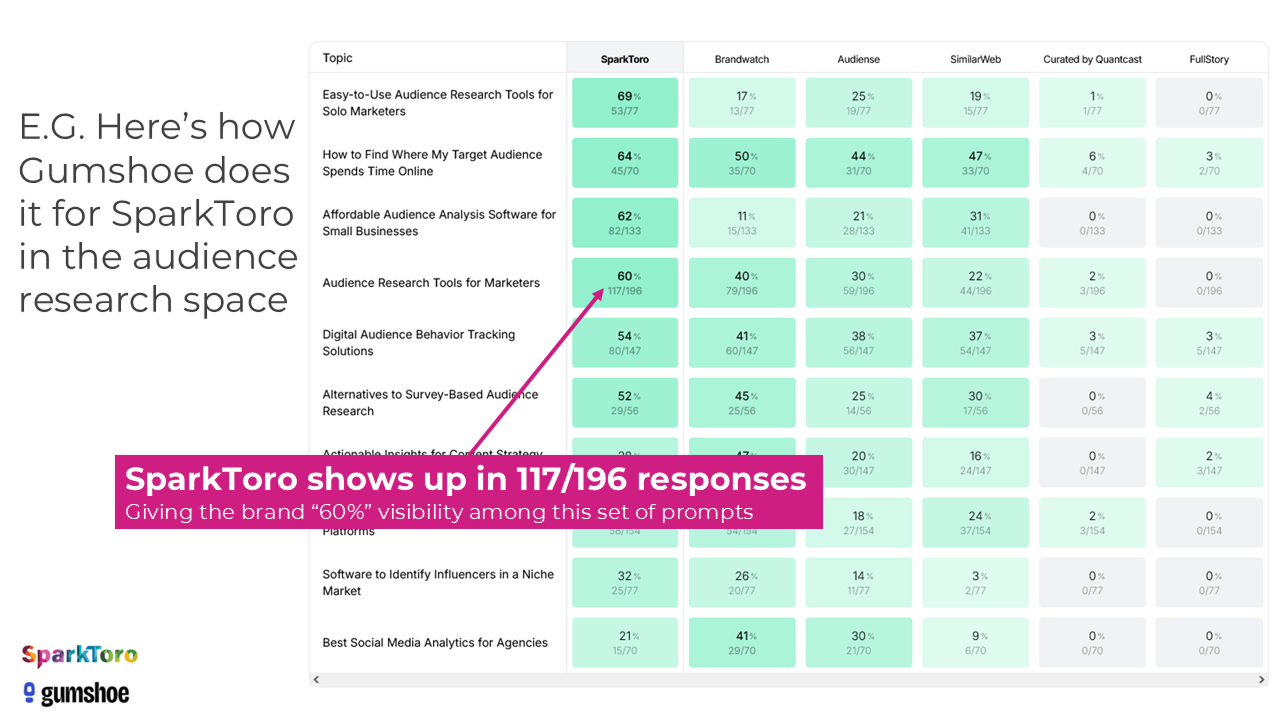
↓ Mention frequency for SparkToro, the company that ran the experiment
A Brand's Survival Depends on Concretizing Intent
Most consumers do not type textbook-perfect questions into a search box. They include typos. They ask questions with ambiguous context. Here is the interesting part: no matter how messy the question, AI reads the 'intent' behind it.
If a slight change in the search term means your brand no longer appears, that brand has not yet given AI enough confidence. A strong brand is the first answer AI calls up for that category, no matter how the consumer phrases the question.
The Smaller the Market, the More Confident AI Becomes
In broad categories with too many options, AI often fails to read a clear intent and returns random answers. By contrast, the more you move into niche B2B solutions or specialized service areas, the more AI answers converge on specific brands.
The narrower the set of options, the more confidently AI cites a brand. This is the basis for why a long-tail keyword strategy becomes an even more powerful GEO technique in the AI era. This is exactly why 238lab emphasizes long-tail keywords and technical stability. The more you narrow the market and strengthen specialization, the greater AI's confidence becomes.
238lab Insight +
Marketing in the AI era is not about 'owning rankings' but 'owning probability.' 238lab designs the technical and strategic foundation that makes your brand the singular 'constant' AI has no choice but to cite, even amid the messiest of questions.
Source report: AIs are highly inconsistent when recommending brands or products; marketers should take care when tracking AI visibility

About the Author
Aiden: SEO Consultant / Marketing
From venture investment to M&A advisory, I design digital growth across the entire corporate lifecycle. As an SEO consultant at 238lab, I focus on building sustainable, data-driven traffic structures. Former Marketing Lead at a venture and startup management consulting firm Former Digital Strategy Team Lead at a corporate finance advisory firm Current Head of Digital Strategy at 238lab