

What Are Google AI Summaries and Naver AI Summaries
Google and Naver AI summaries are a defining example of how search results are no longer simply a list of links, but are shifting toward presenting core answers to user questions first. The key point is that both platforms share the goal of shortening the user's lengthy search journey.
In the past, users had to open multiple pages, compare them directly, and organize the information themselves. Now, search engines first interpret query intent and present condensed core content. This tendency is especially pronounced for complex queries, comparison-type queries, and questions with long context. This shift also means that search engines are evolving from a 'tool for finding links' into an 'interface that presents answers.' Users can understand information quickly, and platforms can improve search satisfaction. For content creators, on the other hand, simply ranking at the top is no longer enough. It has become important to build a strategy that simultaneously provides an information structure that can be cited in summaries and added value that drives clicks to the original source.
Why Do Search Engines Show 'Summary Answers' Rather Than 'Links'?
The biggest reason search engines prioritize summary answers is that user search behavior has changed. Today, users enter sentence-based, question-based, and complex queries more often than single keywords, and they want comparison, judgment, and recommendations all at once, beyond simple information checks. In this environment, merely showing multiple links cannot meet expectations.
In addition, with the advancement of generative AI, search engines have significantly strengthened their ability to grasp query intent, combine context, and integrate multiple sources. Whereas they previously focused on ranking search results, they now weave multiple pieces of information together into a form users can understand immediately. This is both a result of technological progress and the core of competition in search UX. The mobile-centric consumption environment is also an important backdrop. Because navigating multiple tabs and reading on a small screen is cumbersome, users want to quickly grasp the essentials first. AI summaries are a feature that emerged to meet this demand.
In summary, the reasons search engines are strengthening summary answers are as follows.
- Because user questions have become longer and more complex
- To reduce the burden of directly comparing and organizing multiple documents
- Because generative AI technology has improved the quality of summarized and integrated responses
- Because demand for quickly grasping the essentials in mobile environments has grown
In other words, it is more accurate to view AI summaries not as a simple convenience feature but as a result of structural change in the search market.
How Do Google and Naver AI Summaries Appear Differently in Search Results?
Both Google and Naver are strengthening AI-based summary-type results. However, because their search result screen design philosophies and service ecosystems differ, there are also differences in how they are actually experienced. Google tends to show integrated answer blocks that synthesize multiple sources for complex queries. Naver, on the other hand, places summary-type elements within the structure of its own services such as news, blogs, knowledge, Place, and shopping, arranging them by context.
In Google's case, AI summaries can occupy a large area at the top of search results, and related source links are frequently shown alongside them. Users follow a flow of reading the summary first and clicking the source for verification when needed. Naver, by contrast, has traditionally structured its search results around various content cards and service modules, so AI summaries are often placed in a way that helps users understand a specific area. The table below conceptually organizes the differences between the two platforms.
| Comparison Item | Naver | |
|---|---|---|
| Nature | Integrated responses to complex queries | Summary-type elements placed by service context |
| Screen Structure | Emphasis on top-centered answer blocks | Centered on search modules, cards, and its own ecosystem |
| Sources | Presents bundled external web sources | Emphasizes context based on its own data such as news, reviews, and content |
| Clicks | Clicking sources for verification after checking the summary | Combines internal service navigation with movement to detail pages |
| Experience | Closer to 'showing the answer first' | Often closer to 'a summary that aids exploration' |
The important point is that, rather than viewing one as absolutely superior, the perceived utility differs depending on the query type and search purpose. For example, Google-style integrated responses may be useful for comparison-type information searches, while Naver-style structures may feel more natural for local, review, or domestic content searches.

Comparing Placement, Source Display, and Follow-Up Click Structure
To understand the influence of AI summaries, you need to look beyond simply whether the feature exists and consider where it appears, how it displays sources, and where subsequent clicks lead. When a large summary block is placed at the top of search results, the visibility of existing organic search results inevitably becomes relatively lower. This also directly changes user click behavior.
With Google, AI summaries appear at the top first, and a structure frequently emerges in which users check related source links within them. In this case, users can obtain a substantial amount of information on the first screen of search results, making it likely that simple questions end without additional clicks. Conversely, for topics requiring deeper verification, high-intent clicks may occur through the presented source links.
Because Naver's search results are originally composed of various cards and areas, AI summaries often serve as an entry point to a specific content bundle. In other words, users use the summary to set a direction and then move on to news articles, review details, blog posts, Place information, and so on.
The differences by platform can be summarized as follows.
- Placement: Whether the top position is claimed has a major impact on organic search click-through rates
- Source Display: The number of links, arrangement, and click-inducing design differ
- Follow-Up Click Structure: Cases of leaving after only viewing the summary coexist with cases that lead to source verification
Therefore, in SEO practice, you must analyze not only simple rankings but also screen share, the likelihood of source link exposure, and the click path after the summary.
What Differs in Generation Method and Information Scope?
The difference between Google and Naver AI summaries is revealed not only in where they appear but also in how they structure their content. For complex questions, Google has a relatively stronger character of generative integrated summaries that synthesize multiple sources and organize them as if into a single response. This helps users grasp the broader context without reading multiple pages themselves.
Naver, in contrast, tends to emphasize summaries tailored to each service context such as news, reviews, blogs, search cards, and Place. For example, representative summary experiences include helping users quickly grasp lengthy article content or distilling the core features commonly mentioned across many reviews. In other words, Naver is both an integrated answer engine and, at the same time, strongly oriented toward improving exploration efficiency within its own content ecosystem.
However, an important premise is that AI summary results are not always displayed identically. Whether they are activated and how they are expressed can vary depending on the search query, timing, user environment, experimental status, and category characteristics. Therefore, in practice, repeated observation is needed rather than generalizing from a single screenshot.
| Comparison Item | Naver | |
|---|---|---|
| Generation Method | Synthesized responses from multiple sources | Summaries based on service context |
| Strengths | Complex questions, comparisons, explanatory queries | News, reviews, domestic content exploration |
| Information Scope | Oriented toward responses spanning the broader external web | Oriented toward optimizing its own services and search experience |
| Variability | Varies by query, region, and experimental environment | Application methods and exposure conditions may differ by service |
In conclusion, it is easier to grasp the structure by understanding that Google leans relatively more toward 'answer generation' and Naver toward 'exploration efficiency.'
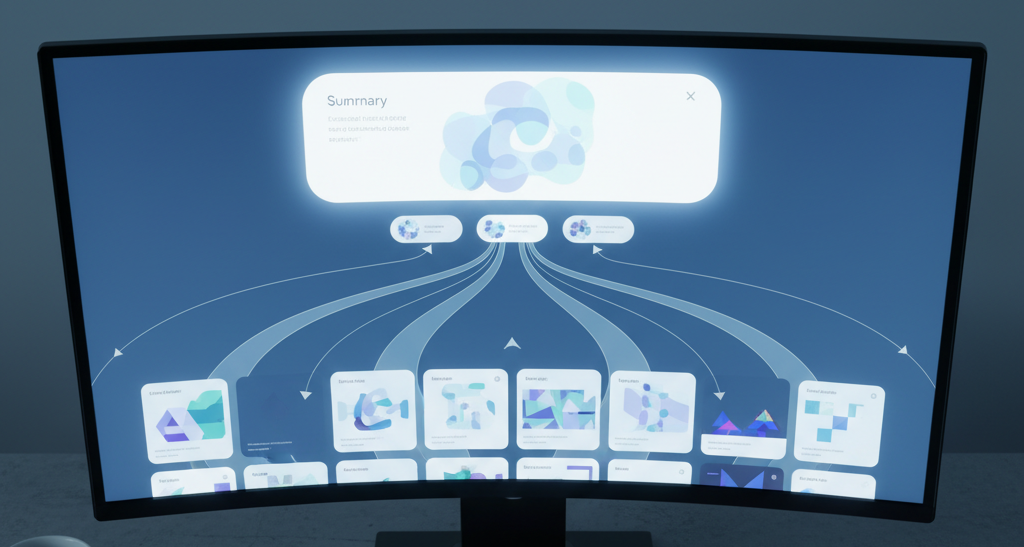
What Changes in the Search Experience Do AI Summaries Bring to Users?
From the user's perspective, the biggest advantage of AI summaries is reduced search time. Without reading many long articles, users can quickly grasp key issues, definitions, and comparison points, improving information search efficiency. The benefit is especially large for entry-level questions, concept comprehension, and situations requiring quick judgment.
However, AI summaries are not always a sufficient answer. For complex topics or issues where context matters, details, exceptions, counterarguments, and the latest updates may be omitted during the summarization process. Therefore, while enjoying the convenience, users must also recognize the need to check sources and review the original text.
The standard for information reliability has also changed. Whereas in the past search ranking was accepted as a kind of trust signal, it has now become important to develop the habit of checking, alongside the summary itself, which sources it is based on, how current the information is, and who wrote it.
The following topics in particular require caution.
- Medical: Diagnosis, treatment, and medication information require verification by credible medical institutions and experts
- Legal: Interpretations vary widely by case, requiring review of official statutes and experts
- Financial: Interest rates, taxation, and investment decisions can yield different results depending on timing and conditions
In other words, while AI summaries make the search experience fast and convenient, you must clearly understand that they do not take on the responsibility of verifying accuracy on your behalf.
How Do Clicks Change?
When AI summaries are introduced, click behavior changes in both directions.
First, simple questions become easier to resolve within the search results page, which can increase so-called zero-click searches. For example, for questions involving basic definitions, simple comparisons, or immediate answers, users are highly likely to not bother opening an external page.
Second, not all clicks simply decrease. For queries requiring comparison, verification, or action, even higher-intent clicks may occur. Users first grasp the big picture through the AI summary, then click the original source to check actual cases, detailed evidence, pricing, procedures, and the latest conditions. In this case, even if the number of clicks decreases, the quality of clicks and the likelihood of conversion can increase.
Therefore, in practice, you should look not only at a simple CTR decline but also at the following metrics together.
- Change in number of clicks
- Dwell time and scroll depth after the click
- Conversion rate, inquiry rate, subscription rate
- Whether brand searches increase
- Return visit rate for the same topic
In summary, AI summaries are not a feature that merely eliminates clicks; they can also function as a mechanism that reduces low-intent clicks and filters for high-intent clicks. Therefore, an approach that changes the very standard for interpreting performance is needed.

What SEO Changes Do AI Summaries Mean for Website Operators and Marketers?
For website operators and marketers, Google and Naver AI summaries are not a mere feature change but a sign that the evaluation criteria of SEO are shifting. Whereas the key used to be where you rank for a specific keyword, what now matters is whether your content has the potential to be referenced and cited in the AI summary area at the top of search results, and whether it provides value worth clicking even after the summary.
For some queries, a decline in organic clicks may indeed occur. This is especially true for definition-type, simple information-type, and quick-answer searches, where AI summaries resolve a substantial part of the user's question. Conversely, however, highly specialized content earns brand trust by being used as a source for summaries and becomes more likely to be chosen in deeper exploration stages thereafter.
For this reason, SEO strategy is shifting from a focus on ranking competition to a focus on information structures worth citing. Well-organized definitions, clear question-and-answer structures, comparison tables, the latest evidence, and author expertise information are all summary-friendly while also serving as favorable signals for search engines to judge trustworthiness.
The practical direction of response is as follows.
- Consider brand trust and conversion value together, rather than total traffic volume alone.
- Separately design top-funnel informational content and bottom-funnel in-depth content.
- Increase structured documents that can be cited as sources.
- Create reasons to click the original source through proprietary data, cases, and interpretation.

Common Traits of Content That Thrives in the AI Summary Era
Content that thrives in the AI summary era is not simply writing stuffed with keywords, but a document that clearly answers questions while being well-organized in structure. Because search engines prefer content from which they can quickly extract the core the user wants, the document design itself becomes a competitive advantage.
Representative common traits are as follows.
- Clear question-and-answer structure
- Core definitions and conclusions presented early
- Many structured elements such as comparison tables, lists, and step-by-step explanations
- Clear author expertise, sources, publication date, and revision date
- Reflection of the latest information and traces of fact-checking
- One core message contained in each paragraph
For example, even when covering the same topic, an article that clearly addresses 'what it is - why it matters - how it differs - what the practical response is' is more likely to be cited than a long-winded one. In addition, in fields where expertise matters, the author's credentials, hands-on experience, and whether official materials are cited can serve as trust signals.
Ultimately, the essence of summary-friendly content is not a technical trick but information quality and clarity of delivery. Because this improves not only search engines but also actual reader satisfaction, it is a stronger strategy over the long term.
How Should You Respond to Concerns About Traffic Decline?
The concern that AI summaries may reduce traffic is realistic. However, it is risky to apply this uniformly to every industry and every keyword. Click declines may be large for informational queries, but demand for visiting the original source remains high at the comparison, purchase, and review stages. Therefore, the starting point of your response should be not fear but impact analysis by query type.
In practice, you need to redesign your performance metrics. Looking only at page views and session counts may make things appear worse, but in reality, increases in brand searches, direct traffic, inquiry conversions, and subscribers may emerge. In other words, you must consider the quality of traffic, not just the quantity.
The execution plan can be organized as follows.
- Design top-funnel content around core summaries.
- Strengthen content for in-depth review with cases, data, checklists, and interpretation.
- Run channels for newsletters, subscriptions, communities, and return visits alongside search traffic.
- Strengthen content linkages that can increase brand-name searches and direct visits.
- Consider long-term trust accumulation and conversion performance together, rather than short-term CTR.
Ultimately, what matters is not passively reacting to search engine changes but clearly creating value that AI summaries cannot replace. That value may be proprietary data, actual operational experience, or industry interpretation and execution guides.

Content Writing and Response Strategy in the Era of Google and Naver AI Summaries
The core of content strategy is now to simultaneously have a structure that is easy for search engines to summarize and a depth that gives readers a reason to click. The most effective approach is an inverted pyramid structure that presents the core answer to the question early in the document and then expands into evidence, cases, comparisons, and exceptional conditions. This raises both user satisfaction and AI summary suitability.
In addition, sentences should be as clear as possible. It is better to contain only one message per paragraph and to clearly present definitions, figures, and conditions rather than abstract expressions. At the same time, to earn human trust, you should present author information, sources, the latest update history, and actual cases together. Documents that AI can summarize well and documents that people trust ultimately overlap to a considerable degree.
Most importantly, you must secure content assets that are difficult to replace through summaries alone. For example, elements such as your own survey data, experimental results, on-the-job insights, actual failures and improvement cases, and differences in application by industry are difficult to fully replace with a short summary. The more such information you have, the more the reason to visit the original source is preserved even when it appears in search result summaries.
The principles to remember from a practical standpoint are as follows.
- Answer first, then expand the evidence afterward.
- Write sentences short and clear.
- Actively use comparison tables, lists, and FAQ structures.
- Make sources and author trust information clear.
- Add actual experience and interpretation rather than information anyone could state.
In conclusion, content in the AI summary era must be designed to simultaneously achieve search engine friendliness and reader persuasiveness to deliver results.
A Writing Checklist Practitioners Can Apply Immediately
The checklist below is a standard that SEO managers, blog operators, and media practitioners can apply immediately when improving documents to fit the Google and Naver AI summary environment.
- Did you place core definitions and conclusions at the very beginning of the document?
- Did you design each subheading to be the answer to one question?
- Did you present the core benefit the reader will gain within the first three paragraphs?
- Did you include structured elements such as comparison tables, lists, and step-by-step explanations?
- Did you contain only one core message per paragraph?
- Did you connect each claim to supporting sources, data, and cases?
- Did you clearly display author information, publication date, and revision date?
- For content requiring timeliness checks, did you leave an update history?
- Did you include proprietary interpretation, cases, and data that AI summaries alone cannot provide?
- Is the reason to click the original source clear?
The content structures to pay particular attention to in practice are as follows.
| Component | Recommended Approach | Expected Effect |
|---|---|---|
| Introduction | Present definitions and conclusions upfront | Immediately satisfy search intent |
| Body Structure | Center on question-type subheadings | Improve summary extraction and readability |
| Information Presentation | Tables, lists, step separation | Improve key comparisons and comprehension |
| Trust Elements | Sources, author, update history | Strengthen expertise and accuracy |
| Differentiation Elements | Cases, experiments, interpretation, on-the-job experience | Improve click incentive and conversion potential |
The purpose of this checklist is not simply to align with search engines, but to create documents whose value remains even when summarized and whose satisfaction is high even when clicked.
238lab Insight +
Please review whether your own content has both 'an information structure that can be summarized' and 'added value worth clicking.' By diagnosing your content and SEO strategy in line with the changes in Google and Naver search, and reviewing internal guides and related analysis articles together, you can establish a more practical direction for your response.

About the Author
Aiden: SEO Consultant / Marketing
From venture investment to M&A advisory, I design digital growth across the entire corporate lifecycle. As an SEO consultant at 238lab, I focus on building sustainable, data-driven traffic structures. Former Marketing Lead at a venture and startup management consulting firm Former Digital Strategy Team Lead at a corporate finance advisory firm Current Head of Digital Strategy at 238lab