

What Is GEO?
GEO (Generative Engine Optimization) refers to a strategy that goes beyond raising rankings on the search results page to designing your content so that generative AI selects it as evidence and a source when constructing its answers. In other words, rather than optimizing only the old flow of "search box -> results list -> click," the core of GEO is optimizing the very structure of "question -> AI generates an answer -> your brand and content are cited within that answer."
GEO emerged as the search environment shifted from "a search engine that lists links" to "a 'generative engine' that directly produces sentences." Search users no longer explore the sites offered by search results on their own; they obtain information through "answers" that generative AI searches for, learns from, and assembles. In that process, services powered by large language models (LLMs) such as ChatGPT, Gemini, Claude, and Perplexity began drawing broadly on web documents, document summaries, and structured data to answer user questions.
This is where GEO fundamentally differs from conventional SEO. If SEO is a framework for optimizing pages to fit crawling, indexing, and ranking algorithms, GEO is a framework for delivering information in a structure that LLMs can easily understand and for being recognized as a trustworthy source. In other words, rather than targeting the search results list, GEO is a strategy that deeply connects your content to the "knowledge graph and answer-generation process" of generative AI.
The Difference Between Traditional SEO and GEO
In the AI search environment, the way people search has changed, so the optimization criteria naturally shift as well. Traditional SEO assumed a flow in which users pick and click one of several links on the search results page. Accordingly, titles, meta descriptions, click-inducing copy, and the quantity and quality of backlinks served as the core metrics.
By contrast, GEO assumes a situation where the user does not directly choose from a search results list. The user poses a single question, and the AI synthesizes multiple sources to deliver a complete answer. What matters here is not "what rank our page holds" but "which sentences and materials the AI uses as the basis for its answer." Thus, GEO is closer to a competition for citation within the answer than a link-centered competition for exposure.
That said, GEO does not replace SEO. Generative AI also refers to traditional signals such as the search index, link structure, and domain trust in order to find reliable information. In other words, SEO is the foundational base that supports the search infrastructure, and GEO is a strategy that adds a new layer of "answer optimization" on top of it. It is more realistic to understand the two strategies as complementary rather than competing.

Why GEO Is Needed: Securing New Traffic Paths
The most direct reason GEO is needed is that going forward, a significant portion of users' information searches is likely to end on the AI-generated answer screen. Services such as Google SGE (Search Generative Experience), Perplexity, and ChatGPT Search all aim to "reduce the effort of visiting multiple sites and provide an organized summary with supporting links on a single screen." Users are already growing accustomed to this approach quickly.
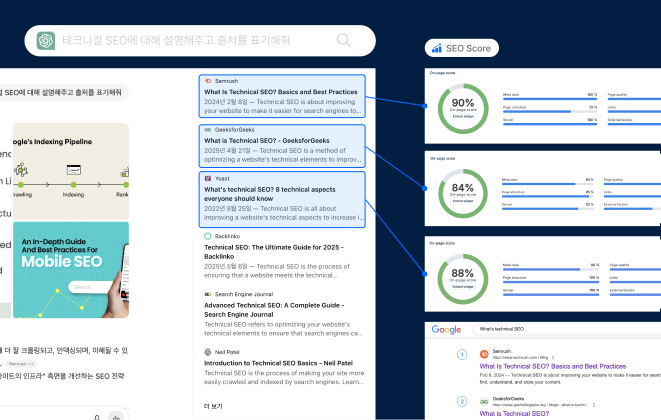
In this environment, the biggest advantage a company site can gain is being included in the reference sources, recommended links, and cited sentences at the top of the AI answer. Links exposed inside and around the answer are often placed in a more prominent position than traditional search results. Users also tend to assign higher trust simply because the source was "recommended by the AI." In other words, GEO directly influences not just visitor counts but also brand trust and expert positioning.
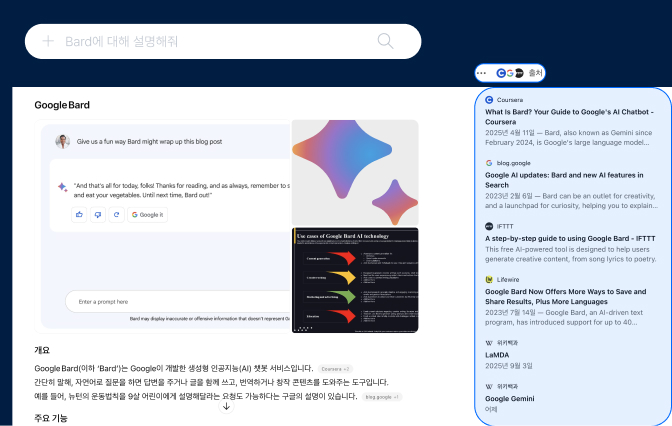
Another reason is that information not addressed in AI answers risks disappearing from the user's cognitive horizon. If a user receives an answer from the AI once and does not search further, then brands and services not included in that answer are naturally excluded from the comparison set as well. In this sense, GEO is also a defensive strategy that reduces the 'risk of becoming invisible.'
Generative AI differs by model in how it utilizes information, and these differences make GEO even more necessary. For example, services such as ChatGPT, Gemini, and Claude each reference external information in different ways - web browsing, plugin and tool calls, document-based analysis, and so on.
Therefore, to design a GEO strategy, a company must continuously observe what types of web pages and structured data the AI reads more clearly, and which information formats it selects as the basis for its answers. This becomes the criterion for judging how the 'differences in how each model uses information' should actually be reflected in our site structure, and ultimately plays an important role in establishing a content base that the AI can naturally reference.
How AI Models Select Content: The Technical Principles of GEO
To properly understand GEO, you first need to identify what factors generative AI references when it processes text and constructs an answer. A common point you can confirm from published research and official documentation is that LLMs basically follow this sequence: after receiving the question as input, they search for and select highly relevant document fragments, then reconstruct that content at the token level to generate new sentences. (*Token: the smallest unit of word fragments, divided by meaning, that AI models use when processing text.)
The first important factor in this process is sentence structure and context. LLMs understand paragraphs in which a topic sentence and its supporting explanation are logically connected more accurately than a fragmented collection of keywords. A front-loaded structure, clear concept definitions, and natural connections between paragraphs help the AI grasp 'what question this paragraph answers.' In the end, writing that is favorable for GEO largely coincides with "writing that is easy for people to read."

The second factor is "fact-grounding." Generative AI learns from various texts during training, but when it actually generates answers, it tends to reference recent information and high-trust sources together. Here, sentences with dates, figures, official definitions, and a clear citation structure function as 'anchors where facts can be verified,' and are more likely to be cited or reconstructed directly into the answer.
The third factor is "structured data (JSON-LD, Schema.org, etc.)." Search engines and some AI services use schema markup to structurally grasp the nature and key information of a page, such as FAQ, HowTo, Article, and Product. Because such structured data is easier for machines to interpret than the body text, from a GEO perspective it can also function as "summary data that is easy for AI to reference."
The final factor is "EEAT (Experience, Expertise, Authoritativeness, Trustworthiness)." Google already emphasizes EEAT in its search quality evaluation guidelines, and this indirectly affects the credibility of the sources that generative AI references. An author bio demonstrating expertise, cases based on real experience, clear source attribution, and transparent company information all act as positive signals not only for SEO but also for GEO.
Practical GEO Optimization Strategies: Building a Content Structure That AI Cites
To apply GEO in practice, you must design content while imagining "which sentences the AI will pick up and use." The most basic strategy is structured writing centered on definitions and concepts. For example, when explaining GEO, it is better to first present a clear definition sentence in the form "GEO is ~" rather than circling around it, and then add the background and reasons afterward. Such definition sentences are well-suited for AI to cite directly or adapt when explaining a particular concept.
The second strategy is to structure the body based on a "logical flow (problem -> principle -> case)." If you first present a question the user might be curious about, explain the principle and structure behind that question, and then connect it to a concrete example or use case, the result becomes easy to understand for both humans and AI. This amounts to creating "a structure that is easy to pick up as the answer to a specific question."

The third strategy is to actively use data, dates, and figure-based expressions. Rather than simply writing "GEO has become important recently," you make AI's use of your content as the basis for an answer easier by clarifying the timing or objectively describing industry trends - for example, "discussion of GEO began in earnest after generative search features were introduced and expanded." However, you should avoid unverified statistics or exaggerated figures, and where citation is needed, it is best to specify a reliable source.
The fourth strategy is to appropriately use schema favorable to GEO (FAQ, Article, etc.). For example, if you mark up questions such as 'What is GEO?', 'What is the difference between GEO and SEO?', and 'How can a company apply GEO?' with FAQ schema, search engines and some AI services can recognize this information separately. This serves to give the AI additional hints through structured data.
Finally, you must strengthen corporate trust signals through brand, author, and source. From a GEO perspective, what matters is not mere traffic but "under what name you are cited." Clearly stating author information and a company introduction at the end of an article, and appropriately linking to relevant research or official documents, can build trust with both AI and people.
Content Types Optimized for GEO
Content optimized for GEO is commonly organized around the 'questions' that searchers would actually pose. Whereas traditional SEO had a structure that matched information based on keywords, GEO conducts search around the 'questions' themselves that users pose in natural language. People who search the keyword 'GEO' usually want to know the definition of GEO, the difference from conventional SEO, how to apply it, examples, and the future outlook. Therefore, it is best to use questions such as "What is GEO?", "Why is GEO needed?", and "What should we do first to apply GEO at our company?" directly as paragraph titles or subheadings.
A Q&A-based article structure here benefits both people and AI. From the person's standpoint, they can click on a title in almost the same form as their own question; from the AI's standpoint, it can easily find the answer block corresponding to a specific question. In fact, in many generative search results, you can confirm cases where FAQ-format or HowTo-format content is summarized or cited.

Another characteristic of content frequently cited in generative search is that it clearly presupposes a specific situation or context. For example, if you narrow your explanation to a target and situation such as "points to consider when a B2B company adopts GEO," the AI can judge this content as a more appropriate basis when it receives that question. Ultimately, writing favorable for GEO is writing where "whose question, and what question, it answers" is clear.
Does GEO Replace SEO?
GEO is not a new rule that replaces existing SEO; it is a concept that extends the scope of optimization to include the answer area that AI generates. The roles of building the search index, discovering pages, and evaluating basic trust are still performed by search engines and traditional SEO signals. On top of that, GEO takes charge of another layer that determines "which sentences will be included in the answer."
Therefore, in actual strategy development, there is no need to view SEO and GEO separately. It is still essential that search bots collect pages without issues, that they are stably reflected in the index, and that they have appropriate keywords and structure. On top of this, reinforcing GEO elements with sentences and structures that are easy for LLMs to understand, question-based organization, and structured data is a realistic approach.
In the search market going forward, a hybrid format in which traditional search results and the generative answer area are provided together is likely to persist for some time. During this period, a dual strategy of securing a base of exposure with SEO and securing exposure inside answers with GEO will determine a company's online visibility.
An Essential Strategy for the AI Era: A Corporate Action Guide for Adopting GEO
In the AI search environment, GEO is no longer a choice but, over the medium to long term, closer to an essential strategy for protecting brand visibility and trust. From a corporate standpoint, in addition to the question 'Is our SEO going well so far?', you must also examine 'How is our content being treated inside AI answers?'
In practical terms, first, you can start by building a list of questions that real users would pose regarding the keywords related to your core services, and writing GEO-friendly Q&A, guides, and columns based on it. Second, you should apply appropriate schema such as Article and FAQ to each page to reinforce structured data, and strengthen EEAT signals with author information, sources, and a company introduction. Third, it is best to directly test your brand and key keywords in generative search services, continuously observing and improving on which types of content get cited.
In summary, SEO is a foundational strategy that solidifies the search infrastructure, and GEO is an expansion strategy for claiming the new space of the AI answer area on top of it. The more a company designs the two strategies together, the longer it can maintain stable inflow and brand trust in the AI search environment.

FAQ
Q1. What is the core definition of GEO?
A. GEO is a strategy that optimizes content so that generative AI selects a specific website's sentences as evidence and a source when constructing answers. It is an approach that strengthens citation competition inside AI answers rather than the competition for search ranking.
Q2. What is the biggest difference between GEO and traditional SEO?
A. SEO is a strategy for raising rankings in link-based search engines, while GEO is a strategy for designing which sentences and structures generative AI will cite when generating answers. The two strategies operate in a complementary relationship.
Q3. Why is a GEO strategy needed now?
A. As users shift toward obtaining information from a single screen generated by AI, content not included in AI answers is increasingly likely to be excluded from the user's set of options. GEO is an essential response strategy for maintaining a brand's visibility and trust.
Q4. On what criteria does generative AI cite content?
A. Generative AI gives priority to content with clear concept definitions, a front-loaded sentence structure, fact-based data, structured schema, and high trust signals (EEAT). These factors play an important role in the process by which the AI extracts sentences and reconstructs them into answers.
Q5. What should a company do first to apply GEO in practice?
A. The first step is to redesign the content structure based on the questions customers would actually pose. Next, you can maximize the GEO effect by reinforcing structured data including Article and FAQ schema, and adding clear definitions, fact-based expressions, author information, and source attribution.

About the Author
Liv: SEO Consultant / Publisher
SEO specialist planner and designer responsible for SEO content strategy, website structure optimization, and search-engine-friendly UX/UI design. Former: UX/UI Design Team Lead Current: SEO Content Design Team Lead at 238lab