
About a week after we send a quote, we follow up with a call to ask how the review is going internally. There's one question we hear often on those calls.
"Other firms charge a monthly fee. Is yours really a one-time project?"
If you're looking into SEO or GEO for the first time, it's a fair question. A firm that manages things monthly sounds like it will keep looking after you, while a one-time project can feel uncertain once it's over.
But look closely at the quotes and you'll often find the difference isn't just how you pay; it's what work the money actually goes toward.
1. Why do quotes for the same SEO and GEO work look so different?
When we ask what's included in a monthly management quote, it often covers publishing articles on blogs or external channels every month, adding backlinks, or running a Naver blog. We've also heard several times that the proposal was essentially a steady stream of informational posts.
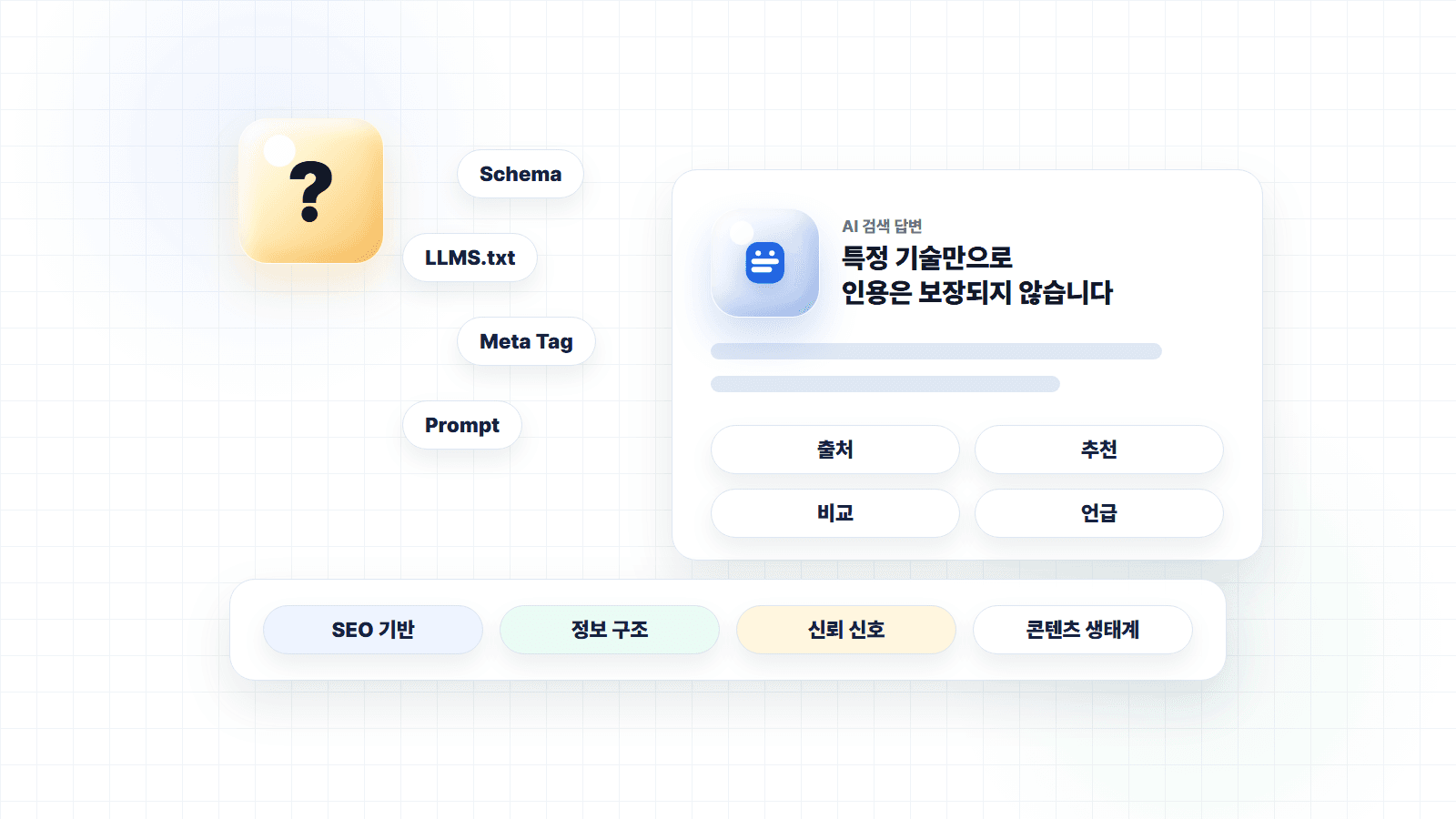
We start a little differently. First, we audit the website to find what's getting in the way of search engines crawling and understanding its pages, and we restructure the site and its content with AI search in mind as well. Then we build the content structure that's needed and measure again, using the same query set before and after the project, how search visibility and citations in AI answers have changed. That's why most of our engagements run as projects of around three months.
Put the two quotes side by side and the difference becomes a bit clearer. One centers on publishing and managing visibility on external channels; the other puts its weight on restructuring the company website and its content. Even under the same name, SEO and GEO, the actual scope of work can be quite different.

2. If external publishing is the focus, the state of the website needs checking too
There's nothing wrong with publishing on external channels in itself.
If the goal is to gain visibility quickly on Naver or a specific channel, running external content can be the better fit. In fact, when a client's goal has been that clear, we've told them up front that a firm specializing in that area might suit them better.
What we see differently is when external publishing continues while the website's basic information and content haven't been put in place. There are more sites than you'd expect where plenty has been written about the company and its services elsewhere, yet the official website itself makes it hard to find detailed service information or case studies.
From the perspective of search engines and generative AI, a large number of external mentions alone is hard to call sufficient.
The official website needs to be a place where information about the company and its services can be verified, and each page needs to be in a state where it can be properly crawled and indexed. If the site isn't being crawled, or key information exists only inside images, growing external visibility may not translate into search traffic to the website or a broader base of information about the company.
It's also worth remembering that visibility on external channels can shift with the platform's algorithm or competing content. One marketer told us that posts that had sat at the top of pages 1-2 on Naver became almost invisible at some point. This approach often requires continuous publishing and upkeep. We covered the relationship between writing lots of blog posts and GEO in more detail in "GEO Myths".
3. So is monthly management unnecessary?
Not at all. We run monthly contracts too. But what we look at first is whether the website's basic structure is in place, and whether there are items that genuinely need ongoing work afterward.
There are clear cases where monthly management makes sense. Companies whose products or references keep growing and need to be reflected on the website regularly are one example. Another is companies that have the raw material internally but lack the capacity to write, so articles need to be built up on the website periodically. And if you want to review changes in AI answer citations and competitor movements together every quarter or half-year, monthly operation can be the right fit.
What these cases have in common is that the monthly work either stays on the website or gets reused in later operations. Conversely, we don't take on contracts that consist solely of external publishing while the website's basic structure is still unresolved, because the scope of improvement that remains on the website itself can be limited.
4. You've received a monthly management quote. What should you check first?
If you've received a quote, it's better to check what work gets done each month before looking at the price.
The actual work differs quite a bit depending on whether it manages the content and structure inside the website, or centers on publishing to external blogs and media.
You should also look at what remains after the contract ends. On external channels, further publishing and upkeep may stop when the contract is over, but the structure and content applied to the website can continue to be used in later operations. Finally, it's worth checking how results are measured. Whether the report counts only published posts, or also tracks website traffic, search visibility, and changes in AI answer citations, says a lot about what the management is for.

The agency selection criteria in "What Is GEO?" also cover what to check before signing, so it's worth reading alongside this post.
5. How do we decide in an actual consultation?
We review the state of the website before deciding on a pricing model. For a company that has used its domain for a long time, already has plenty of content, and is left with only technical issues, a one-time cleanup can be enough. When we spoke with a business running an online store with a large product catalog, we told them monthly management wasn't necessary. They already had ample product information, so we judged that the priority was to organize the structure so search engines could read it properly.
For a company with almost no content, the approach is a little different. Even after the technical work is done, there isn't enough information to add to the website. In those cases, we present the option of building up articles and case study content on the website together over a set period.
There have also been cases where we advised against a monthly contract. One clinic already had a substantial number of articles written by its nurses. Rather than spending money producing new articles every month, we judged it was better to move the existing articles onto the website in a form search engines could read, and then set up the structure and guidelines so the team could write directly in-house afterward.

That's why, in consultations, we don't start by saying whether monthly management is needed. We decide on the contract model after looking at what needs fixing first on the current website, how much content is already available to use, and whether there are items that will need ongoing work afterward.
In short, before deciding whether to pay monthly, the question to settle is where that monthly work goes and how it accumulates.
It's hard to say that either monthly management or a one-time project is always the right answer. Depending on the company's situation, both can be appropriate.
But if you're paying every month, you need to be clear about what work that money buys and what remains after the contract ends. If monthly management is what your situation calls for, it's worth looking at how the monthly work carries over into the website and its future operation, rather than ending with the contract period.

About the Author
Liv: SEO & GEO Consultant / Publisher
SEO specialist planner and designer responsible for SEO content strategy, website structure optimization, and search-engine-friendly UX/UI design. Former: UX/UI Design Team Lead Current: SEO Content Design Team Lead at 238lab