
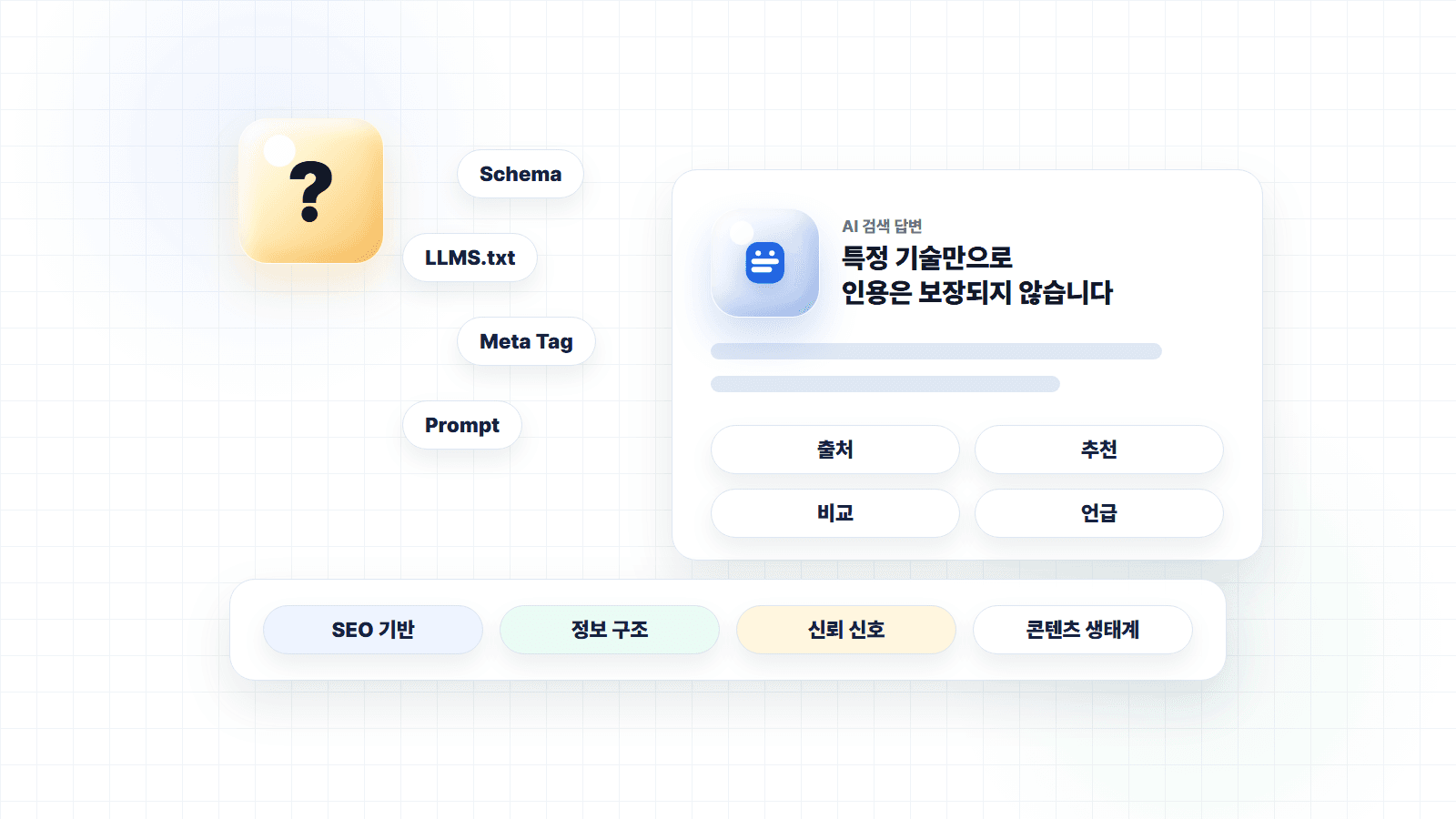
In consulting engagements and GEO-related inquiries, we frequently encounter clients who approach GEO as though it were an entirely new marketing methodology. Questions like "Is there a specific technique that gets our brand cited in AI answers?", "Does adding Schema do the trick?", and "Will creating an LLMS.txt file improve our visibility?" are among the most common we hear.
These questions are entirely understandable. SEO itself evolved over a long period around concrete execution items — technical optimization, content structuring, meta information, and sitemaps. Organizing pages so search engines could read them better, placing keywords strategically, and adding structured data were all practices that genuinely moved the needle. It is only natural, then, that many people assume GEO works similarly — that there must be a distinct set of configuration values to make your site "look good to AI."
But approaching GEO purely through that lens makes it easy to miss the point entirely. There is a clear gap between what the market often calls GEO and the GEO that actually produces measurable results. To be fair, GEO is becoming more structured over time. Tools for monitoring AI search visibility are emerging, and frameworks for tracking brand mention rates and citation share within AI answers are gradually taking shape. Even so, GEO remains a discipline that cannot be solved with a single tag, a single file, or a single prompt.
In this post, we will clarify what GEO is, why it has gained attention so rapidly, and where the most common misconceptions lie — all grounded in data. The conclusion comes first: GEO is not a technique for fooling AI. It is much closer to the work of building a brand information structure that AI can genuinely trust.
So, What Exactly Is GEO?

GEO stands for Generative Engine Optimization. It refers to the practice of increasing the likelihood that your brand or content appears as a cited source, recommended option, comparison candidate, or authoritative reference when users ask questions within generative search and answer environments — such as Google AI Overviews, AI Mode, ChatGPT, Perplexity, and Gemini.
If traditional SEO was about being discovered more effectively on the search results page, GEO is about ensuring that AI selects and understands your information in the process of constructing its answers. Where users once clicked through multiple links in search results to compare options themselves, AI now increasingly aggregates, synthesizes, and summarizes information on their behalf. Which brands appear in those AI answers, which sources get cited, and what context surrounds those citations — all of this is becoming progressively more consequential.
That said, treating GEO as entirely separate from SEO is a mistake. In its official guidance published on May 15, 2026, Google stated that optimizing for generative AI search features remains, from a Google Search perspective, an extension of SEO. This is because Google's AI capabilities operate on the foundation of its search index, RAG, query fan-out, and existing search quality systems.
GEO is therefore less a "new methodology replacing SEO" and more the next stage of SEO as it expands into AI answer environments. Where traditional SEO was about helping search engines discover, understand, and trust your pages, GEO builds on that same foundation — ensuring that when AI combines multiple sources to construct an answer, it selects your information as a trustworthy ingredient.
Why Has GEO Become Such a Hot Topic?

The most fundamental reason is that the way users seek out information is changing rapidly. In the past, when someone had a question, they would type keywords into a search bar, scan the results, and open multiple pages to compare. Today, a growing share of users simply ask AI directly. They pose questions that are far more specific and decision-oriented: "Is this service worth it?", "Which is better, A or B?", "What solution fits our company's situation?", "Which vendors should I look at to solve this problem?"
The data supports this shift. According to Graphite's 2026 analysis, global AI usage sessions have reached approximately 56% of search engine session volume, with U.S. estimates around 34%. When the same analysis isolates informational queries specifically, the figures are 28% globally and 17% in the U.S. (as reported by Search Engine Land). The exact numbers depend on how you define the metric, but the core point is clear: AI has already become an information discovery channel that is too significant to ignore.
What matters here is not the narrative that "Google is dying and AI will replace it entirely." If anything, the overall search pie is growing. Users turn to Google, ChatGPT, Perplexity, YouTube, and Reddit — often within the same research session. From a business perspective, this simply means there is one more surface area where you need to be present. If the top of the first search results page was the critical battleground before, now the context in which your brand is understood at the moment AI composes its answer matters just as much.
We were not quick to hype GEO ourselves. But at a certain point, we noticed we were instinctively turning to AI answers before search results when looking up information — and that was the moment this shift started to feel less like a trend and more like a structural change. Since then, analyzing real service and brand data has consistently confirmed that the heart of GEO is not a new trick — it is the construction of an information ecosystem that AI can trust.
Myth 1: There Must Be a Specific Technical Method for GEO
This myth is half right and half wrong. We are not saying technical factors are irrelevant. Crawlability, indexability, clear information architecture, Schema, product and organization markup, page performance, and duplicate content management all still matter. The problem is that none of these function as a "special button that guarantees AI citation."
When we look at internal data alongside external research, brands that appear frequently in AI search results tend to have already established a reasonable degree of trust within traditional search. Ahrefs' analysis from March 2026 found that approximately 37.9% of URLs cited in Google AI Overviews also appeared in the top 10 organic results for the same query. That share has declined compared to earlier figures, but it still signals a meaningful connection between SEO standing and AI citation.
This is not surprising. To construct answers, AI also searches the web, breaks queries into sub-questions, and retrieves trustworthy candidate sources. Rather than arbitrarily surfacing obscure pages, it is far more likely to draw from sources that have already demonstrated quality and credibility within the search system.
In our experience, if SEO is "the work of making search engines discover and trust your site," then GEO is best described as "the work of making your information easy for AI to use as answer material" — built on top of that same SEO foundation. The truth is clear: there is no single silver bullet in GEO. Instead, you need to build an environment where AI can collect your information more easily, understand it more clearly, and trust it more confidently.
Myth 2: Publishing a High Volume of Blog Content Is Enough

Again, this is half right and half wrong. Blog content remains a powerful asset. Few content formats are as effective at building topical authority, addressing search queries, and articulating which problems your brand solves best. It worked well in traditional SEO and continues to work today.
From a GEO perspective, however, the approach of "packing everything into a single blog post" has real limitations. Rather than summarizing one document in full, AI answers rapidly pull from multiple sources, compare them, and synthesize them. Google specifically notes that its AI features use query fan-out — expanding the original question into multiple related sub-queries to search against.
For example, imagine a user asks, "What is GEO?" AI may not treat this as a simple definitional lookup. It might simultaneously reference sub-questions such as "How does SEO differ from GEO?", "How does AI search citation work?", "How effective is LLMS.txt?", "What effect does Schema have on GEO?", and "How do you measure AI search performance?" — combining answers to all of these in its response.
In GEO, therefore, the structure of a core piece of content supported by targeted supplementary content matters more than one monolithic article. If you have a main piece titled "What Is GEO?", the stronger approach is to connect it to supporting content on "AI Overview citation mechanics," "The real-world impact of LLMS.txt," "How Schema influences GEO," and "How to measure AI search visibility."
This approach also reduces the processing cost for AI. When each page has a clearly defined topic, well-organized headings and body structure, and explicit key claims backed by evidence, it becomes significantly easier for AI to comprehend the content and consider it as a citation candidate. Ultimately, what matters is not the raw number of posts, but how well the information is organized to match the natural flow of user questions.
Myth 3: Setting Up Schema, LLMS.txt, and Similar Configurations Will Do the Job
On this one, the answer leans closer to "no." That is not to say Schema or LLMS.txt are entirely meaningless — but expecting GEO results from these elements alone is the wrong approach.
In its official guidance published on May 15, 2026, Google clarified that LLMS.txt, AI-specific markup, separate Markdown files for AI, and excessive chunking are not requirements for appearing in Google's generative AI search features. Google also explained that AI search optimization is not a separate technical framework distinct from traditional SEO — it is an extension of optimizing for the search experience.
The key insight here is that information structure comes first, and tags are tools that support that structure. Schema helps search engines understand information that is already well-designed. But layering Schema on top of an empty or poorly organized information structure does not create trust. The same applies to LLMS.txt. It can serve as a useful supplementary document that consolidates key site information, but it is not a mechanism that directly produces AI recommendations or citations.
Consider this scenario: if product details vary across pages, if service descriptions differ between your blog and landing pages, and if pricing and feature information is outdated, adding Schema will not resolve the underlying problem. The information AI would need to reference is simply unclear.
Technical tags, then, are best understood not as the starting point for GEO, but as organizational tools applied after the fact. The prerequisite is that your brand, products, services, expertise, supporting evidence, and comparative information are coherently structured across the web. Only then do technical elements like Schema and crawl policies play a meaningful role in delivering that information more effectively.
Myth 4: AI Citations Will Drive an Explosive Increase in Traffic
Another common misconception about GEO is the expectation that being cited by AI will significantly boost website traffic. Based on the current data, however, there is little evidence that AI citations translate directly into large-scale traffic increases.
According to a 2025 Pew Research Center analysis, when Google AI summaries appeared in search results, only about 1% of total visits came from users clicking links within those AI summaries. Even clicks on traditional search results were lower when an AI summary was present — at 8%, compared to 15% when no AI summary appeared. In other words, AI answers tend to complete a substantial portion of the user's information-seeking journey within the answer itself, rather than driving clicks outward.
There is, however, an important counterpoint worth noting. While raw traffic may not increase significantly, the quality of users who do arrive can be meaningfully higher. Users who reach your site via AI have already asked their question, made comparisons, and received an initial answer — they visit to verify or take the next step. They are less exploratory browsers and more "validated prospects arriving to confirm a recommendation."
This is precisely why GEO performance should not be judged on session volume alone. The value of AI citation lies not in traffic quantity, but in conversion efficiency, brand trust, entry into the consideration set, and capturing the decision-making context upstream. That said, the degree varies considerably by industry. There are data points showing that AI referral conversion rates outperform organic in certain B2B, SaaS, and professional services contexts, while other studies of large-scale e-commerce found ChatGPT referrals converting at lower rates than Google Search.
A more accurate framing, then, is this: AI citation is less a channel for explosive traffic growth and more a channel for converting lower traffic volume into higher-intent visits. The core KPIs for GEO should extend beyond simple visitor counts to include brand mention rate within AI answers, citation share, AI referral conversion rate, branded search growth, and assisted conversions.
So, How Do You Actually Do GEO?

With all of that context established, how should you actually approach GEO? To state it directly: GEO is not a problem solved by adding a specific tag or creating an AI-dedicated document. It is a process of organizing your brand's information structure so that both search engines and AI can understand it, designing content around the actual flow of questions users ask, and ensuring that information is discovered consistently across multiple touchpoints.
The first area to address is foundational SEO. Site architecture, internal linking, meta information, snippet eligibility, page speed, and mobile usability are best understood as the baseline layer of GEO. Since AI ultimately references content that exists on the web, these factors have not become less important — if anything, they demand even more attention than before.
If your pages are not being crawled properly, are not indexed, or are failing to communicate critical information clearly to search engines, they are equally unlikely to be selected reliably by AI.
The next step is designing around question flows rather than individual keywords. Where traditional SEO centered on targeting specific keywords, GEO requires you to consider the full range of questions users are likely to ask AI. For instance, "What is GEO?" naturally expands into: "How does SEO differ from GEO?", "What does it take to get cited in AI search?", "Are Schema or LLMS.txt helpful?", and "How do you measure AI citation performance?"
Rather than writing content around a single keyword in isolation, it is more effective to design content based on clusters of related questions that reflect how users actually think and search.
Content strategy must also shift from individual blog posts to building complete information structures. A single article that attempts to cover everything has inherent limitations. AI does not evaluate a single page in isolation — it references multiple sources and multiple content formats simultaneously. The more your core explanation pages, topic-specific posts, comparison content, FAQs, case studies, product pages, data-driven reports, and external mentions are interconnected and mutually reinforcing, the stronger your position. The goal is to generate a consistent signal: "This brand provides reliable, consistent, authoritative information on this topic."
Presenting information in formats that are easy for AI to process is also important — though this does not mean writing in some AI-specific style. Content that is clear and well-organized for human readers is equally accessible to AI. Use specific, descriptive headings. Limit each paragraph to a single core message. Clearly distinguish definitions, comparisons, and supporting evidence. Tables, lists, FAQs, summary sentences, cited sources, and last-updated dates all contribute positively. Schema can be used as a supplementary layer at this stage, but it does not fabricate information that does not exist — the underlying information structure must already be sound.
Consistency of brand information across the web is equally critical. AI does not limit itself to your homepage; it references information distributed across the entire web. If your company name, service names, category labels, key features, pricing, target customers, location, and core value proposition are described differently across channels, AI will struggle to form an accurate understanding of your brand. Across your website, blog, press coverage, directories, review platforms, social profiles, and video descriptions, your brand's problem-solving position must be communicated consistently.
Finally, your measurement framework needs to evolve as well. GEO cannot be evaluated solely through search rankings or visitor counts. You need to track whether your brand is being mentioned within AI answers, whether it is being cited as an actual source, which queries are routing users to competitors instead, and what conversion rates look like for AI referral traffic specifically. AI citation functions less as a channel that floods your site with visitors and more as one that sends users who have already been pre-qualified by the answer they received. As a result, inquiry rate, demo request rate, consultation conversion rate, and branded search growth may prove more meaningful indicators than raw visit volume.
To summarize: GEO is not a technique for fooling AI. It is the work of building a brand information structure that AI can trust. Consistently accumulating information that is discoverable by search engines, understandable to AI, and worthy of selection by users — that is the most realistic and effective GEO methodology available today.
References
- Google Search Central, "Optimizing your website for generative AI features on Google Search"
- Google Search Central, "AI features and your website"
- Graphite, "AI Is Much Bigger Than You Think"
- Search Engine Land, "AI assistants now equal 56% of global search engine volume"
- Ahrefs, "Update: 38% of AI Overview Citations Pull From The Top 10"
- Pew Research Center, "Google users are less likely to click on links when an AI summary appears in the results"
- Search Engine Land, "ChatGPT, LLM referrals convert worse than Google Search: Study"
- Semrush, "ChatGPT traffic analysis: Insights from 17 months of clickstream data"

About the Author
Liv: SEO & GEO Consultant / Publisher
SEO specialist planner and designer responsible for SEO content strategy, website structure optimization, and search-engine-friendly UX/UI design. Former: UX/UI Design Team Lead Current: SEO Content Design Team Lead at 238lab