
Marketing competition in the legal market has already passed its tipping point. Keyword bid prices (CPC) rise more than 15% every year, and the cost of outsourced Naver (Korea's dominant search engine, ~58% market share) blog top-ranking services climbs alongside it. At this point, if your marketing spend growth is not matched by retainer revenue, you need to question the "structure" of your marketing.
"Inquiries come in, but they don't convert to retainers." "The whole day goes to free consultations." This is not a problem with the attorney's sales ability. It is a failure of channel strategy that buys only "low-purchase-intent traffic" from "keywords that don't make money" in the first place.
In this column, we analyze why the center of gravity in legal marketing must shift to Google SEO, from the perspectives of "data (Traffic Quality)" and "algorithm (Search Logic)."
What Is SEO?
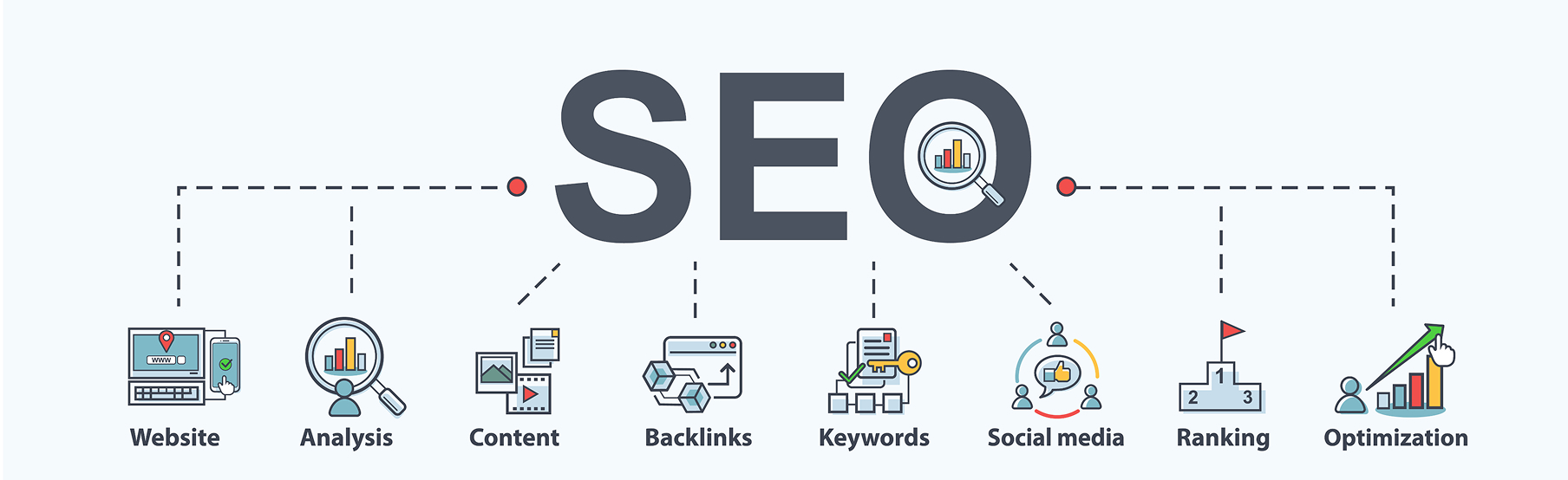
First, to help frame this column, let us briefly explain "SEO." SEO stands for "Search Engine Optimization." It is a technical marketing approach that structures a website the way search engines prefer, securing "Organic Traffic" without ad spend. Unlike "paid ads" that depend on "bid prices," SEO fixes structural flaws in a site to establish a fundamental exposure advantage. That makes it an asset-type channel with high long-term ROI (return on investment).
The Structural Gap in Search Intent Between Naver and Google: "Shopping" vs "Solving"
When a client types a keyword into the search bar, they carry a specific search intent. For example, they search with a defined purpose: "I want general consultation about divorce law," or "I'm suing my spouse's affair partner and want an experienced attorney."
Naver and Google differ structurally in this "search intent." The structural gap arises because each platform's way of arranging information (UI/UX) forces a distinct user behavior pattern.
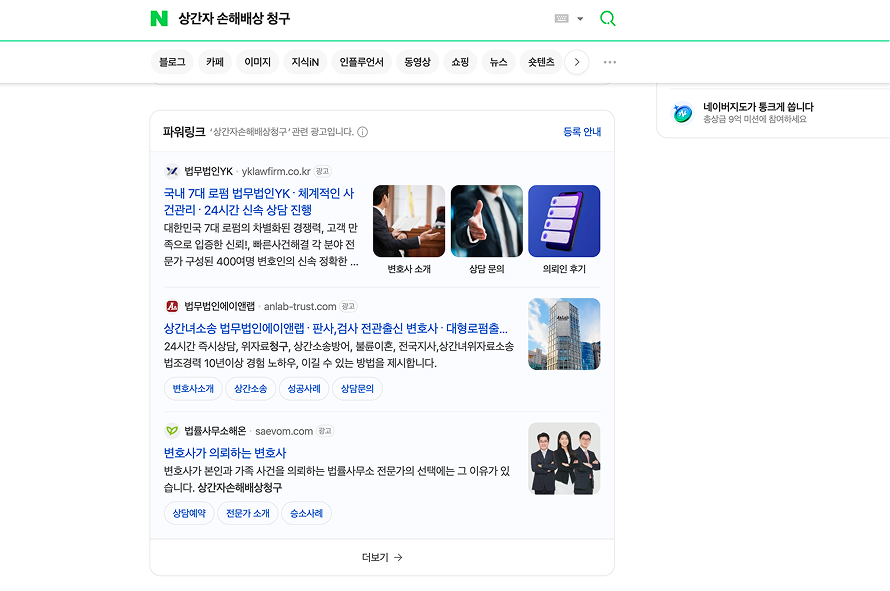
Naver's search screen pours out "ads, maps, and blog images" all at once. This visually driven UI leads users to compare and shop across multiple providers rather than read information deeply.
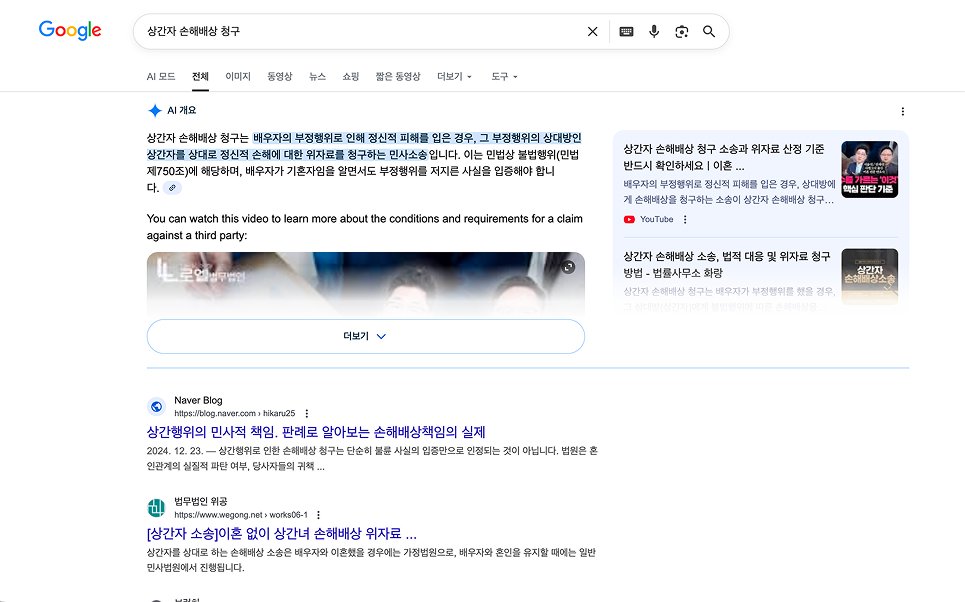
Google, by contrast, minimizes image and ad exposure and arranges information around text. This information-first layout naturally leads users into search behavior aimed at finding "the logic to solve a problem."
As these two structures hardened, Naver in Korea became optimized for shopping, reviews, and community-based interactive content consumption. Google, meanwhile, is recognized as a professional search tool for problem-solving and information discovery.
1. Naver: Short-tail Information Discovery (Low Intent: Casual Browsing)
- Main keywords: "divorce attorney," "sex crime attorney cost," "law firm recommendation"
- User mindset: Quickly compare and list multiple providers, wanting immediate information
The shorter the search term (short-tail), the broader the user's needs and the fiercer the competition. Traffic volume is high, but many users are merely at the stage of comparing prices or conditions, so the persuasion cost (CPC) to convert them into actual retainers can run high.
2. Google: Long-tail Problem Solving (High Intent: Active Drive to Solve)
- Main keywords: "first-offense DUI license revocation," "affair-partner alimony lawsuit dismissal cases," "how to file a defamation complaint"
- User mindset: Seeking legal interpretation and practical solutions tailored to their specific situation
The longer and more specific the search term (long-tail), the lower the search volume, but the higher the share of clients with a clear purpose. In other words, they are at the stage of looking for directly applicable solutions, procedures, and similar cases, not just browsing. So when an inquiry comes in, it is far more likely to convert into a retained case.
A marketing budget matters when it is spent securing "valid client data" that leads to actual revenue, not just "click counts." From this perspective, Google SEO can function as the most efficient funnel for precisely filtering high-intent prospective clients. Therefore, when evaluating marketing, the rational approach is to look beyond mere "top ranking" and prioritize whether the channel fits your conversion rate and retainer goals.
The Difference in Cost Structure: Volatile Spending vs Digital Asset-Building
The channel you should choose changes depending on whether you view your marketing budget as "a cost spent every month" or as "an asset whose value accumulates over the long term." Put simply, the channel choice differs depending on whether you pay "rent" or buy "real estate."
Ads are a classic volatile channel: the moment the budget runs out, the traffic disappears with it. SEO, by contrast, functions as a digital asset that, once the exposure structure is in place, keeps generating traffic over time.
This naturally raises the question: "Then why is it hard for Naver SEO to be sustainable?" The reason lies in Naver's platform characteristics. Naver is structured to prioritize its own ecosystem (blogs, cafes, etc.) in search results, which makes it structurally difficult for external websites to sustain top rankings through SEO alone.
In particular, Naver blogs weight internal platform signals such as "account power," "activity level," and "recency" more heavily than "information quality" or "site trust." As a result, even if you pay to push a blog to the top, its ranking often wobbles or disappears within a month or two.
Google, by contrast, determines rankings by comprehensively assessing "domain authority," "content quality," "site structure," "technical completeness," and more. This structure gives a website that has once settled at the top a protective shield that competitors cannot easily overtake. This is exactly why Google SEO should be approached as a strategy for building a long-term traffic asset, not a short-term result.
Marketing for the AI Era: GEO Is Built on SEO
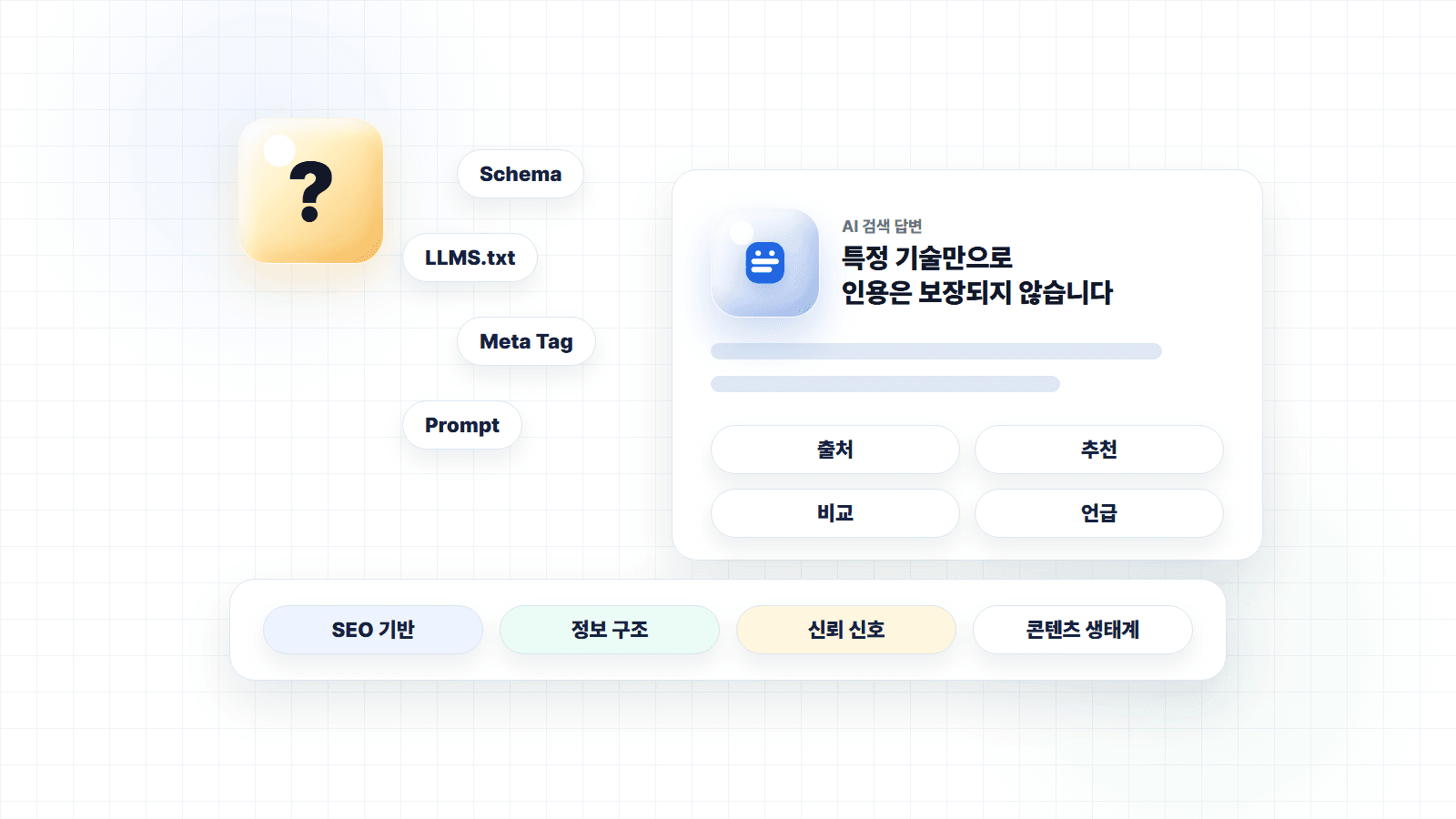
As the AI search era arrives, the competitive landscape of marketing is rapidly shifting beyond simple "top ranking" to a battle over which data generative AI trusts and which websites it cites. Generative AI such as ChatGPT, Perplexity, and Claude all prioritize information from websites with AI-friendly technical structures when answering. In other words, they cite SEO-stable websites first and surface them to users.
That is why future marketing performance and business success may hinge on whether you prepare for GEO (Generative Engine Optimization). In the legal field especially, content consistency, expert verification, and on/off-page trust weigh heavily in how AI models judge. So if you do not quantify and structure your expertise through Google SEO, you are highly likely to be excluded from the AI answer space.
Ultimately, the answer for legal marketing to stay competitive in an AI search environment is clear: build a solid foundation with SEO, then structure an expansion into GEO on top of it.
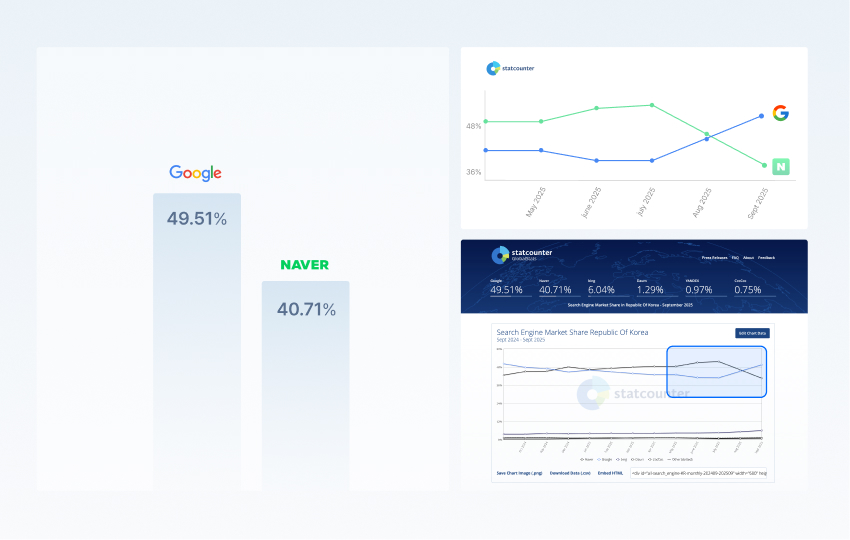
As of September 2025 (Statcounter, South Korea), Google's domestic search share reached 49.51%, surpassing Naver. With generative AI-based search spreading rapidly on top of this, future legal marketing success now depends on whether you claim GEO first, not on simple top rankings. Amid this shift, SEO is no longer optional. It is an essential strategic asset that determines competitiveness.
If you are tired of dummy client data and exposure-only marketing that never converts into retained cases, consider an SEO channel that designs a meaningful client data structure.

About the Author
Liv: SEO Consultant / Publisher
SEO specialist planner and designer responsible for SEO content strategy, website structure optimization, and search-engine-friendly UX/UI design. Former: UX/UI Design Team Lead Current: SEO Content Design Team Lead at 238lab