

The 5-year survival rate for early-stage startups is about 27%
That means for every 10 businesses launched, 7 disappear. This is real data on Korean startups, and the number of companies that fail is higher than most people expect.
70% is not a low probability. Even the service running this blog cannot easily escape it. But there is one theory that best summarizes how to become a startup that does not collapse. That theory is chasm theory.
First introduced by Geoffrey Moore, it explains why startups fail to enter the market early using a fitting framework. Today we will examine this theory in detail.
The word 'chasm' itself carries a negative meaning

The dictionary definition of chasm is 'a deep crack or gorge in the ground, rock, or stratum.' This gorge, the 'chasm' that swallows many startups, is a gap you must cross.

The image above is a diagram of Geoffrey Moore's chasm theory.
According to its analysis of the 'chasm' that sits at the early stage of a business, customer behavior breaks down into 5 stages. You can see that the concept of the early adopter originated from this chasm framework.
The core of this theory is that most startups fail to cross the 'gorge.' It also addresses the obstacles many innovations face when trying to move from the early market into the mainstream.
The theory that gave us the term 'death valley'
It divides the market into 5 groups and argues that you must move from the small early-adopter market into the larger majority-user market.
These groups genuinely exist in the market. Let us look at these 5 technology adoption lifecycle groups.
1. Innovators
A group of technology enthusiasts who want to try new innovations. They willingly take on risk and are often the first to adopt a product. They love new technology for its own sake and enjoy seeing, using, and discussing tech they have never encountered.
2. Early Adopters
This is the group that effectively decides the fate of a new technology. They are slightly more cautious about adoption than innovators, but the IT YouTubers who voice their opinions to the early majority belong here.
3. Early Majority
This group begins buying once early adopters have used and 'proven' the technology. They focus on the 'benefits' returning to them rather than on others' opinions, and judge those benefits by 'validation and proof.' They rely on recommendations from others who have already used the product.
4. Late Majority
This group is skeptical of new technology. They view new tech negatively and are the ones leaving comments on websites. They only begin adopting once it has become the standard.
5. Laggards
The slowest group to adopt technology. To persuade this group to adopt something new, you need a salesperson's pitch or a strong recommendation from someone close to them.
The space between innovators and early adopters is called the initial chasm, or the death valley.
Looking only at the theory, it is easy to assume that most startups fail in the transition from innovators to early adopters. But the actual behavior of startups tells a different story. Far more startups collapse in the transition from the early market to the mainstream market than in any movement within the early market itself.
So what is the conclusion?
Right. 'That's where most of them collapse' is too disappointing a place to stop. So this theory also offers solutions.
The solutions chasm theory proposes
Chasm theory proposes 4 strategies in total and explains how to cross the chasm successfully. Here is a short summary.
1. Target a niche market
This solution says to focus on the specific market segment where your service solves a clear problem better than any alternative.
2. Build a service concept
This solution says to continuously monitor whether your service meets the needs and expectations of the target niche market, and notes that partnerships or alliances are sometimes necessary.
3. Increase early awareness
This solution says to actively leverage early adopter opinions as viral content to capture the attention of the early majority, who rely more heavily on proof and recommendations.
4. Shift the marketing strategy
This solution says to move from a service-centric strategy to one that emphasizes solutions, customer relationships, and improved product support.
Did that resonate with you?
Throughout reading the book, I kept thinking that the customer adoption lifecycle model framework was excellent, but the solutions were mostly vague and abstract.
Targeting niche markets, building concepts - all good, but there is something more fundamental. So, borrowing a little from the principles of growth hacking that startups use to glide through their early stage, let me share the core of how to cross the chasm in short form.
The core of crossing the chasm: you have to change how you speak
Telling you out of nowhere to change how you speak may sound confusing.
But more founders than you would expect do not realize that the message they deliver to customers is insufficient. Let us look closer.

What counts as something you would call 'innovation or new technology'? 'Steve Jobs' iPhone?' 'Semiconductor nano processes?' 'Sony's noise cancellation?' In reality, innovation on this scale is usually a project led by large companies rather than typical startups.
And even those large companies see dramatically different results when their products hit the market.
Sometimes Company B has the better technology, yet customers go to Company A. And that happens far more often in the market than you would think.
So let us pose a question from the perspective of how you speak.
'Why use only messages that resonate with early adopters?'
With AI as a massive turning point right in front of us, it is hard for most technology to be new and innovative. To consumers, the phrase 'it's convenient to use' lands far better.
Right. The most common mistake startup founders make in the early stage is exactly this: tailoring their message to the 'innovators and early adopters.'
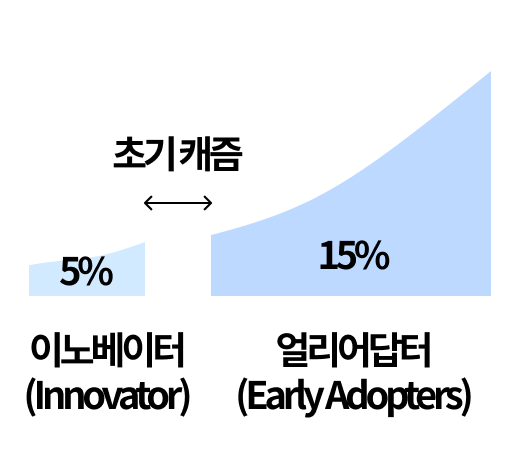
When you fixate only on the initial chasm between innovators and early adopters, you become trapped by the idea that you must cross the 'death valley.' Instead of telling customers 'here is how this benefits you,' you focus only on 'I have to show how good my technology is.'
Even if you secure customers all the way through the early adopters that way, you are still delivering your message to consumers who make up just 20% of the total market. Here you have to ask yourself once more: what do customers really want to hear?
So the real way to cross the chasm
The real conclusion is this: let go of your attachment to how innovative your business is, and deliver a message that more customers can respond to.
To illustrate, the technologies actually praised as innovative do not call themselves 'innovative.'
Even the famous Steve Jobs described the iPhone as 'this is a small computer,' not 'it contains some innovative technology.'
Likewise, he said 'we put the functions of a computer into an MP3 player,' not 'we built a proprietary technology called iOS that lets you integrate various applications...'
Of course, Steve Jobs' distinctive presence played a part, but what matters more than you would expect is delivering the message from the perspective of the 'audience' - that is, the 'customer.'
Next time, under the topic 'Cracking Chasm Marketing,' we will create content on the actual hands-on methods for crossing the chasm.

About the Author
Joshua: Lead SEO Consultant
- Built a zero-cost structure generating KRW 1.2 billion in annual revenue through SEO alone - Closed a KRW 700 billion deal through SEO alone - Low-cost, high-efficiency marketing specialist Former) Marketing Lead at a financial services firm Current) Runs SEO/GEO agency 238lab Track record) Led multiple SEO consulting projects, including Korea's No.1 AI community